


Walls Within Europe

Ethnic Enclaves, Block Voting and the Populist Feedback Loop
Europe’s migration question is rarely political in the abstract. It becomes political when it acquires a visible and durable social form. That form is often through ethnic enclaves: neighbourhoods in which diaspora populations are territorially concentrated. Ranging from La Courneuve outside Paris to Molenbleek in Brussels, these concentrated settlements reshape how migration is seen, narrated and contested. Migration ceases to be a statistic and becomes a social landscape.
At the national level, political discourse about the scale of migration is often exaggerated. The political effect of migration is however not determined by national averages alone. Eurostat reports that as of January 1st 2024, non-national citizens accounted for 9.9% of the EU population and 13.9% for foreign-born. This minority share has become politically explosive through the uneven spatial concentration. The OECD Municipal Migration Database shows that migrants accounted for 11% of the population across OECD countries in 2022, while also documenting sharp variations in migrant population concentrations across municipalities and local areas. Cross-national work on 1,396 European sub-regions likewise finds that immigrants, especially those from outside Europe, are often less spatially integrated with native populations. The political impact of immigration is therefore shaped less by Europe-wide averages than by dense local pockets where migration becomes highly visible.
This article argues that ethnic enclaves should primarily be understood as products of labour incorporation and insufficient national planning. Once formed, these enclaves do not simply concentrate people; they also concentrate labour-market vulnerability and dense ethnic-minority social networks that often develop partly outside the everyday institutions and associations of the ethnic majority. This concentration lowers the cost of ethnic mobilisation, which in turn raises the salience of migration as a political issue. As migration becomes a political cleavage contested by parties, populist and traditional right-wing actors are especially well placed to convert these local tensions into national electoral advantage.
How Are Enclaves Formed?
Most regions with intense ethnic minority concentration were never created through a single or deliberate policy. They emerged through overlapping historical dynamics. Post-war labour recruitments filled gaps that persisted within metropolitan economies, but they were often housed in the peripheries where housing was cheaper. Social housing that developed in this period amplified this outcome by further channeling low income households towards these particular zones. With the basis for ethnic enclaves established, family reunification and chain migration reinforced this pattern by directing newcomers towards these zones where diaspora support networks and informal labour market information already existed. Therefore, the formation of ethnic enclaves must be considered as the result of cumulative and self-reinforcing layering rather than a single founding decision.
Boterman, Mustard and Manning have studied this phenomenon in Amsterdam and have proposed four major factors that contribute to this segregation, turning it into a multidimensional process.
Evenness - The measure of unevenness in the distribution of one group across neighbourhoods
Clustering - A measure of whether these migrant-heavy neighbourhoods are isolated from one another or are inter-connected, forming a more continuous territorial bloc.
Exposure - Measures the degree of everyday contact between groups. Much of this depends on access to shared spaces, such as schools and shops, where most ordinary interactions take place.
Concentration - This factor captures how compressed a group is within the city’s overall geography; in other words, whether a large share of the population is confined to a relatively small space.
While these four factors aid and reproduce segregation on their own, it is important to note their mutual relationships. If migrants are unevenly distributed, concentrated into a small number of districts, and those districts are clustered together, then separation becomes more socially durable. Additionally, if exposure between migrants and natives is low, there are fewer policy options to reduce segregation.
Even where welfare states are comparatively generous, those transfers do not automatically dissolve spatial separation if transport, housing and schooling continue to sort populations in the same way.
Enclaves as Economic and Social Formations
Enclaves are also labour market formations. In many European settings, concentrated migrant districts are closely linked to sectors marked by insecure work, subcontracting, and weak protections that often sit outside collective bargaining agreements. Some commonly seen examples of these sectors are logistics, agriculture, domestic labour, construction and hospitality. The enclave becomes socially important by concentrating workers whose incorporation into the economy is structurally unequal.
Italy and Spain provide a particularly relevant example of this tendency. In Italy’s logistics corridor, migrant labour is central to warehousing and freight systems, which are structured by subcontracting and insecure employment. The importance of recent labour disruptions, such as the April 2024 strike, is therefore not just that migrant workers protested, but that a concentrated workforce in the same sector could act collectively and disrupt a strategically important supply chain. Their leverage came from the fact that precarious labour had already been gathered into the same economic and territorial spaces. In Spain’s Huelva area, the seasonal berry economy reveals the same relationship in a different form. Export agriculture depends on a large migrant workforce being kept physically close to production during harvest season, often in precarious housing and under highly insecure conditions. In June 2025, the Spanish government and local mayors agreed on a protocol to improve housing and services for temporary workers after these conditions drew sustained criticism from NGOs and increasing attention from local authorities. These cases illustrate the idea previously mentioned: enclaves are not merely places where migrants happen to live, but spaces closely connected to sectors of the economy that rely on insecure and concentrated labour.
This is where enclaves become politically consequential. Dense communities lower the costs of collective action. They make it easier to identify local leaders, spread information, convene meetings, build associations, organise demonstrations and target turnout. Enclaves make organisation feasible.
This concentration gives the enclave a dual political character. On the one hand, it creates the social density through which workers and residents can organise, coordinate and make collective claims. On the other hand, because that same concentration is bound up with visible separation, it can also deepen exclusion and make surrounding populations more likely to interpret the enclave as a site of unfairness or disorder.
This gives us a more concrete understanding of why bloc voting persists on ethnic grounds, rather than common arguments attributing it to the tribalist nature of voters. Cooperman shows that bloc voting can function as a strategy of accountability: a way for communities to demonstrate coordination and thereby make politicians responsive. Vermeulen, Kranendonk, and Michon make a related argument in their study of Amsterdam. The key variable is not just the number of co-ethnic voters in an area, but the social and political interaction that takes place within concentrated neighbourhoods. Concentration makes coordination easier, and this makes bargaining more credible.
This is also why the enclave has a dual character. It is not simply a place of exclusion, nor is it simply a place of empowerment. Demireva and Zwysen’s ESS-based analysis captures this ambivalence well. They find that the majority of residents in enclaves do not suffer clear direct economic harm from living there, but they do show greater support for the far right and lower satisfaction with democracy. At the same time, migrants face an economic enclave penalty, while the second generation experiences poorer job quality and greater dissatisfaction with democracy. The enclave therefore produces different kinds of outcomes for different groups: not straightforward deprivation for all, but a mix of economic disadvantage, political resentment, and democratic estrangement.
Majority | Migrants | Second generation | ||||
Not in enclave | Ethnic enclave | Not in enclave | Ethnic enclave | Not in enclave | Ethnic enclave | |
Active | 0.90 (0.30) | 0.88 (0.32) | 0.88 (0.32) | 0.83 (0.38) | 0.90 (0.30) | 0.90 (0.30) |
Employed | 0.92 (0.27) | 0.88 (0.33) | 0.89 (0.32) | 0.8 (0.40) | 0.92 (0.28) | 0.82 (0.39) |
Occupational status | 46.82 (18.88) | 46.16 (19.11) | 43 (20.61) | 40.74 (20.05) | 48.47 (18.8) | 43.67 (19.16) |
Vote far right | 0.06 (0.24) | 0.09 (0.29) | 0.01 (0.11) | 0.03 (0.16) | 0.05 (0.23) | 0.05 (0.23) |
Feel close to far right | 0.06 (0.23) | 0.08 (0.27) | 0.04 (0.2) | 0.04 (0.2) | 0.07 (0.25) | 0.09 (0.28) |
Satisfied with democracy | 5.61 (2.33) | 5.01 (2.56) | 6.36 (2.36) | 6.1 (2.48) | 5.64 (2.39) | 5.07 (2.56) |
Feel unsafe when walking in local area after dark | 0.14 (0.35) | 0.33 (0.47) | 0.15 (0.36) | 0.31 (0.46) | 0.17 (0.37) | 0.34 (0.47) |
Victim of burglary/assault last 5 years | 0.22 (0.42) | 0.3 (0.46) | 0.22 (0.42) | 0.24 (0.43) | 0.24 (0.43) | 0.33 (0.47) |
Employment rate in regional area (centered) | 0.08 (5.17) | −1.12 (5.85) | 0.48 (4.65) | −0.82 (5) | 0.85 (3.83) | 0.05 (4.51) |
Several immigrant/minority friends | 0.12 (0.33) | 0.21 (0.4) | 0.48 (0.5) | 0.58 (0.49) | 0.25 (0.44) | 0.47 (0.5) |
A few immigrant/minority friends | 0.39 (0.49) | 0.41 (0.49) | 0.35 (0.48) | 0.31 (0.46) | 0.44 (0.5) | 0.33 (0.47) |
No immigrant/minority friends | 0.49 (0.5) | 0.38 (0.49) | 0.17 (0.37) | 0.11 (0.32) | 0.31 (0.46) | 0.2 (0.4) |
Speak country language at home | 0.98 (0.15) | 0.97 (0.16) | 0.57 (0.49) | 0.45 (0.5) | 0.94 (0.23) | 0.88 (0.32) |
Average economic and political outcomes for those living in migrant enclaves and those who do not - Credits: Demireva and Zwysen
From Leverage to Salience
The fact that enclaves generate leverage is not, by itself, enough to explain their wider political impact. Migrant communities have always organised. What makes enclaves especially consequential is that the leverage they generate is also highly visible. This visibility usually raises the salience of migration far beyond the enclave itself.
That matters because salience is what turns local tension into wider political conflict. Not every social reality becomes a major issue. It becomes one when political actors and media systems elevate it above competing concerns and frame it as urgent. Migration mobilisation can contribute to this process even when its aims are inclusionary, which they seldom are. Broad claims of cheaper housing, better labour market conditions and fairer treatment are entirely justified, but the manner in which it is stated matters. These claims are often reframed as an attack on existing state resources and that the social order is being transformed too quickly. This asymmetry that is produced tends to have a more negative effect than a positive one. Dennison, Geddes, and Talò show that opposition to immigration is often more intensely felt than support for immigration. This is evident in their examination of the Dutch case: Wilders’ support was not driven simply by an aggregate shift in public opinion against immigration, but by the salience of immigration as an issue. When immigration dominated the agenda, anti-immigration voters became easier to mobilise.

This is why enclave politics is so combustible. Enclaves do not merely segregate. They make migrant organisation visible, and visible organisation raises the chance that immigration becomes a high-priority issue for the broader electorate.
The wider cleavage literature helps clarify why. Increasingly, Western European politics is not structured only by the traditional class divide, but by a broader conflict between universalism and particularism, openness and closure, inclusion and bounded belonging. The enclave becomes politically potent because it is one of the local sites through which this wider conflict is interpreted. For one side, it is evidence of unequal incorporation requiring institutional repair. For the other, it is evidence that the national community is being territorially fragmented. The enclave becomes a concrete object through which larger ideological conflicts are made visible.
Once migration becomes salient, the enclave becomes especially valuable to populist actors because it is both visible and interpretable. A concentrated neighbourhood can be turned into a national symbol much more easily than a diffuse demographic trend can. A housing estate, a school gate, a migrant market, a strike, a headscarf, a protest, multilingual shop signs — these are politically useful not because they are statistically representative, but because they are symbolically legible.
This is why the rhetoric of “parallel societies” is so effective. It condenses complex realities of labour-market segmentation, housing concentration, institutional exclusion, and uneven settlement into a simple accusation: that national life is splitting into distinct and incompatible worlds.
Germany provides the clearest recent case. TRT World’s 2025 discussion paper on the AfD describes how refugee and immigration politics were framed through claims about social fragmentation, border weakness and “parallel societies.” The AfD’s 20.8% second-vote share in the February 2025 federal election shows how electorally powerful this framing became. What matters for the argument here is not only the content of AfD rhetoric, but the mechanism. Concentrated migrant settlement supplied the images and local cases through which national political storytelling became persuasive.
The key point is that public opinion need not shift dramatically for this to work. Once immigration rises to the top of the agenda, even centrist voters may begin to treat it as a valence issue– something requiring competent management rather than ideological judgment. Under those conditions, restrictive or hardline positions can appear less as extremism than as administrative seriousness. That is how the Overton window moves: not through deep attitudinal changes, but through agenda setting.
This is the terrain of welfare chauvinism. Once enclaves are associated in public debate with housing scarcity, school competition, strained services, or unequal public spending, they become local symbols of a broader distributional argument. The enclave is no longer only culturally coded. It is redistributively coded as well.
That is what makes the ethnic so politically useful. The same neighbourhood that gives migrants leverage can be recast as proof that public goods are scarce and unfairly allocated. In other words, the enclave’s political problem is not simply visibility. It is visibility attached to leverage.
The Politics Around the Enclave
The effects of enclaves are not confined to those who live inside them. Often, they intensify in the surrounding areas. This is one of the most important reasons enclave politics travels so far beyond the neighbourhood itself.
The native voter most likely to move sharply toward anti-immigration politics is not always the one living in the most diverse district. Often it is the one living nearby: close enough to observe visible change, but not close enough for everyday social contact to make that change ordinary. The distinction between direct contact and adjacent exposure is crucial here. Routine social contact can reduce hostility. Nearby visibility without integration can sharpen it.
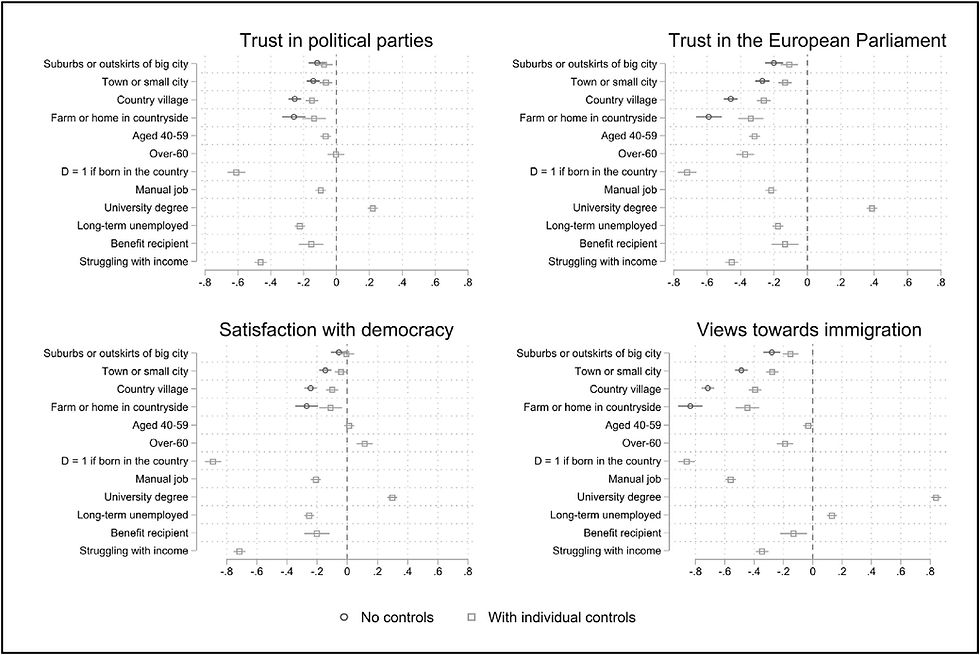
Luca and Kenny’s work is useful precisely because it warns against overstating a crude urban-rural divide in Europe. Their analysis suggests that political divergence is moderate, issue-specific, and highly variable across countries. That provides a useful framework for this article because it pushes the analysis away from a simplistic city-versus-countryside model and toward a finer territorial one. In migration politics, the decisive line often lies not between “urban” and “rural” in general, but between concentrated migrant districts, their adjacent suburbs, and the surrounding spaces that experience migration mainly through visibility rather than routine contact.
Not all neighbouring voters respond in the same way. Class, education, labour-market insecurity, age, prior contact, and existing ideological dispositions all matter. Demireva and Zwysen’s findings can be reconsidered in this context: ethnic majority respondents in enclaves show stronger far-right support and lower democratic satisfaction, not simply because of direct economic harm, but because concentrated diversity can be interpreted as a loss of control, fairness, or influence. Backlash is therefore not only material and not only cultural. It is interpretive and institutional.
This is the full political contradiction of the enclave. The same space can generate organisation for those inside it and resentment among those around it. It alters how different parts of the electorate experience the same social transformation.
Why This Matters for Democratic Politics
The importance of enclaves therefore lies not only in segregation itself, but in what segregation does politically. They sort political experience. They shape how migrants encounter labour markets, institutions, and opportunities for mobilisation. They shape how nearby majorities interpret visibility, threat, and deservingness. They shape how parties identify constituencies and narrate conflict. The same spatial concentration that lowers the cost of migrant organisation, also lowers the cost of populist storytelling.
This is why the article’s core claim is not just about migration, but about democratic representation. Democracy depends on parties competing over broadly framed programmes and citizens being able to hold elected officials accountable through institutions that claim universal legitimacy. Once politics becomes increasingly mediated through territorially concentrated groups and the anxieties they provoke elsewhere, that representative logic can shift. Parties begin speaking less in the language of general programmes and more in the language of selective reassurance: protect this district, contain that one, reward this group, discipline another.
That is the deeper significance of enclave politics. It pressures democracies to choose between two paths. One is universalist incorporation: expanding equal institutions so that spatial concentration does not harden into political estrangement. The other is fragmented competition: a politics of territorial reassurance, differentiated deservingness, and symbolic containment. The enclave matters because it makes that choice harder to avoid.
Conclusion
Ethnic enclaves in Europe should therefore be understood neither as simple failures of integration nor as straightforward engines of minority empowerment. They are both enabling and divisive. They arise through labour recruitment, housing allocation, family settlement and uneven urban development. Once formed, they provide support, social density and real political leverage to populations that might otherwise remain fragmented and weak. But that same leverage also raises the salience of migration and makes enclaves politically useful to actors seeking to narrate social fragmentation, distributive unfairness and loss of control.
Enclaves matter politically not simply because they segregate migrants, but because they transform spatial concentration into migrant bargaining power, and that bargaining power into populist backlash. They are not peripheral to Europe’s contemporary politics. They are one of the principal sites through which Europe’s next political divisions are being made.
Bibliography
Aktaş, K. (2025). The rise of the far right in Germany: Implications for refugee and immigration policies (Policy Outlook Discussion Paper). TRT World Research Centre. https://researchcentre.trtworld.com/wp-content/uploads/2025/03/Rise-of-the-far-right-germany-last-version.pdf
Boterman, W. R., Musterd, S., & Manting, D. (2020). Multiple dimensions of residential segregation: The case of the metropolitan area of Amsterdam. Urban Geography. Advance online publication. https://doi.org/10.1080/02723638.2020.1724439
Ciccarelli, R. (2024, April 30). Inchiesta sulla logistica in Italia: Oggi è sciopero per 24 ore. Il Manifesto. https://ilmanifesto.it/inchiesta-sulla-logistica-in-italia-oggi-e-sciopero-per-24-ore
Cooperman, A. D. (2024). Bloc voting for electoral accountability. American Political Science Review, 118(3), 1222–1239. https://doi.org/10.1017/S0003055423000989
Demireva, N., & Zwysen, W. (2021). Ethnic enclaves, economic and political threat: An investigation with the European Social Survey. Frontiers in Sociology, 6, 660378. https://doi.org/10.3389/fsoc.2021.660378
Dennison, J., Geddes, A., & Talò, T. (2017, March 3). The Dutch aren’t turning against immigration – The salience of the immigration issue is what drives Wilders’ support. EUROPP – European Politics and Policy, London School of Economics. https://blogs.lse.ac.uk/europpblog/2017/03/03/the-dutch-arent-turning-against-immigration/
Lichter, D. T., Parisi, D., & Ambinakudige, S. (2021, March 12). The spatial integration of immigrants in Europe. N-IUSSP. https://www.niussp.org/migration-and-foreigners/the-spatial-integration-of-immigrants-in-europe/
Luca, D., & Kenny, M. (2024). Drifting further apart? Europe’s trends of urban-rural political polarisation should not be overstated. Political Geography, 114, 103181. https://doi.org/10.1016/j.polgeo.2024.103181
Moody, O., Conradi, P., & Crossland, D. (2025, February 24). German election results 2025: Conservative leader prepares for coalition talks. The Times. https://www.thetimes.com/world/europe/article/german-election-results-2025-afd-cdu-csu-35m72dl5b
Organisation for Economic Co-operation and Development. (2023). The OECD Municipal Migration Database. OECD Publishing. https://www.oecd.org/en/publications/the-oecd-municipal-migration-database_a79b007d-en.html
Saiz, E. (2025, June 18). El Gobierno y los alcaldes de Doñana sientan las bases para dignificar a los temporeros. El País. https://elpais.com/espana/2025-06-18/el-gobierno-y-los-alcaldes-de-donana-sientan-las-bases-para-dignificar-a-los-temporeros.html
van Londen, M., Phalet, K., & Hagendoorn, L. (2007). Civic engagement and voter participation among Turkish and Moroccan minorities in Rotterdam. Journal of Ethnic and Migration Studies, 33(8), 1201–1226. https://doi.org/10.1080/13691830701613991
Vermeulen, F., Kranendonk, M., & Michon, L. (2020). Immigrant concentration at the neighbourhood level and bloc voting: The case of Amsterdam. Urban Studies, 57(4), 766–788. https://doi.org/10.1177/0042098019859490


The link between ethnic enclaves, block voting, and the populist feedback loop is especially thought-provoking—social fragmentation can reshape politics in ways polling misses. I’ve been using https://audio-transcriber.online/audio-transcription-examples
The link between ethnic enclaves, block voting, and the populist feedback loop is especially compelling—it shows how social fragmentation can reinforce political polarization. I’ve been using https://kapwing.online
The link between ethnic enclaves, block voting, and the populist feedback loop is especially thought-provoking. I’m looking into comparable demographic data and have been using https://trellisai.online
The link between ethnic enclaves, block voting, and the populist feedback loop is especially sharp here—identity politics can reinforce the very divisions it claims to address. I’ve been using https://art-list.pro/art-styles/cyberpunk