


Can Nature Ease Sovereign Debt?

Sovereign debt and the geopolitics of environmental bargainig
As debt distress and climate vulnerability collide, countries have begun using forests, reefs, and carbon sinks as bargaining tools in sovereign finance using nouveau financial instruments like debt-for-nature swaps. Whilst debt-for-nature swaps are not a cure for sovereign-indebtedness in sovereign finance, but rather a sign of incessant fiscal stress, it is a tool for alleviating this stress. This is geopolitically relevant because whilst it empowers countries to bargain for favorable terms of debt, what constitutes as “environmental value” or what is “credit-worthy” especially when concerning natural capital is dictated by frameworks set forth by the Global North. It can be made mainstream with some reforms.
Opening gambit: the new asset on the negotiating table?
Sovereign debt has long been negotiated through austere fiscal adjustment and repayment terms. However as climate risks mount, especially for emerging economies, coral reefs, forests and carbon sinks are emerging as new sources of climate-adjusted fiscal space. In May 2023, Ecuador completed what the Inter-American Development Bank described as “the world’s largest debt-for-nature conversion.” This transaction was backed by an 85 million USD IDB guarantee and a 656 million USD political-risk insurance from the United States International Development Finance Corporation. Crédit Suisse was the global lead arranger for this transaction.
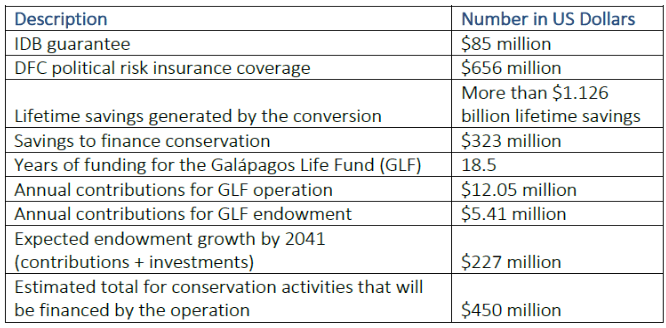
By refinancing public debt on cheaper terms, this conversion is estimated to generate lifetime savings of ~1.2 billion USD and 323 million USD financing for biodiversity conservation. The $323 million for marine conservation in the Galápagos Islands over the next 18.5 years, includes approximately $12.05 million of new funding annually and around $5.41 million annually, on average, to capitalize an endowment for the Galapagos Life Fund (GLF) and the Reserva Marina Hermandad.
Two years earlier, Belize had executed a similar deal, a 364 million USD debt conversion for marine conservation, which according to The Nature Conservatory reduced the country’s debt by 12% of GDP, and created long-term conservation financing, by locking in a commitment to protect 30% of Belize’s Ocean.

Belize offers a useful case study because it makes the financial maneuvering visible. Existing debt was repurchased at a discount, new financing was raised on better terms, and part of the savings was channeled into a conservation fund. The structure also shows why these deals are not simply bilateral bargains between a debtor and its creditors.

They rely on arrangers, insurers, conservation organizations and governance vehicles that make the transaction credible to investors. The conservation fund was a tertiary structure but rather, it was part of the deal’s machinery. The same structure that lowered Belize’s debt also locked future savings into marine protection, which is why the transaction mattered to both investors and conservation groups involved.
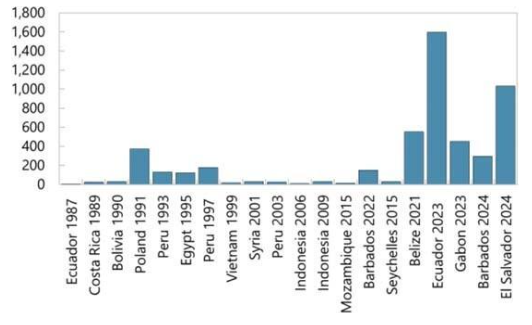
Figure 3 shows both the promise and the limits of debt-for-nature swaps. The instrument has existed since the late 1980s, but most earlier transactions were small. The recent wave is different: Belize in 2021, Ecuador in 2023 and El Salvador in 2024 stand out as much larger, more capital-market-oriented transactions. However, the uneven pattern also matters as these deals remain episodic rather than systematic, with large gaps between transactions and wide variation in size. That is why they should be read as an emerging tool, not a functioning asset class. The World Bank estimates that emerging economies paid in the midst of rising interest rates on external borrowing a record 1.4 trillion USD to service foreign debt (406 million USD in interest payments) in 2023. This squeezes funds available for investment in education, healthcare and climate, which are all essential for development traits. At the same time, Lazard’s sovereign advisory team notes that the climate challenge is colliding with already elevated debt burdens. According to IMF estimates, emerging and developing economies may require around $2 trillion annually by 2030 for climate mitigation alone. Debt-for-nature swaps have existed since the late 1980s, but the recent wave is larger and more capital-market oriented. Belize in 2021 and Ecuador in 2023 stand out sharply. Yet even these larger deals remain small relative to the external debt burdens facing developing economies.

Figure 4 shows that sovereigns have not ignored labelled climate finance. Government-issued sustainable bonds expanded sharply after 2019, with issuance peaking in 2021 before moderating in 2022 and 2023 as global financing conditions tightened. Green bonds remained the largest category, accounting for 48.2% of issuance in 2023, while social and sustainability bonds also became material parts of the market. The point is not that climate-linked finance is absent. It is that the market remains uneven, rate-sensitive and too small to resolve the debt-climate squeeze on its own.
Thus, the rise of natural-capital finance is not a breakthrough-solution or eureka moment in sovereign finance. rather an adaptation to the world we live in, where traditional debt remedies and climate finance promises are both inadequate and sometimes inappropriate. Lazard is explicit in its opinion that well-structured instruments can help “in some cases meaningfully” but also claims that climate mobilization will not solve acute over-indebtedness and that climate-linked features can complicate already difficult restructurings. The IMF and World Bank also share a similarly cautious opinion on such instruments. Debt-for-development swaps can be useful when they provide short-term relief and fit a sustainable debt path, but they are not appropriate tools for restoring debt sustainability in countries that require deep, comprehensive restructuring.
This is precisely where the shift and the caution becomes more significant. Countries facing fiscal scarcity and insufficient assistance from convention restructuring solutions, they begin to draw on whatever assets remain available to them outside of a typical balance sheet. Forests, reefs and carbon sinks are being drawn into financial arrangements not because they solve the debt problem, but because they can be used to reshape it. What emerges out of this is not necessarily a new solution, but rather a new kind of deal. Countries discuss debt relief in terms of environmental commitment instead of solely fiscal terms. Effectively, the global south countries are exchanging stewardship of global public goods for financial breathing space. It introduces new actors, new conditions, and new asymmetries into sovereign finance and turns what was once a technical exercise into something closer to a negotiation over valuations and control.
The debt–climate squeeze
Debt distress is a binding constraint on emerging economies who are at the forefront of the climate crisis. For many sovereigns, access to capital markets has become more expensive, more volatile, and sometimes even closed (one out of every four emerging market and developing economies (EMDEs) has effectively lost access to international bond markets).

According to the World Bank International Debt Report, external debt stock of EMDEs has risen sharply for the past decade. External debt owed by low- and middle-income countries rose from USD 6.27 trillion in 2014 to USD 8.94 trillion in 2024, an increase of roughly 42.5%. Long-term debt grew even faster, by about 53.8%, while official creditor exposure rose by more than 83%. This is consequential for two reasons: the debt stocks are larger and creditor structures are complex given poor access to international capital markets. A sovereign seeking relief must now negotiate across private bondholders, banks, bilateral lenders and multilateral institutions, each with different incentives. At the same time, the scale of required climate investment is also rapidly expanding with emerging and developing economies estimated to need around USD 2 trillion annually by 2030 for mitigation alone. This is for mitigation alone, adaptation needs more funds, adding further pressure. For countries already struggling to service debt, this creates a financing problem that cannot be solved by borrowing more.
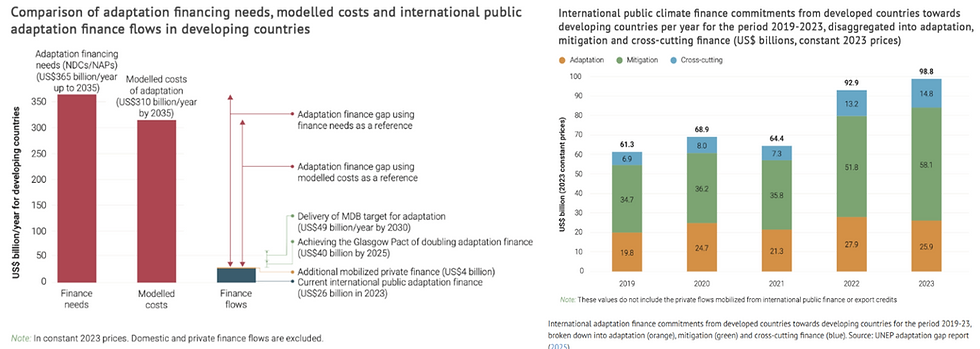
Figure 6 shows the scale of the adaptation finance gap. UNEP estimates adaptation financing needs in developing countries at around USD 365 billion per year up to 2035, while modelled adaptation costs stand at around USD 310 billion annually. Yet international public adaptation finance flows reached only USD 26 billion in 2023. In other words, current flows cover only a small fraction of estimated needs. Moreover, the interaction between these trends is not merely additive, but they are reinforcing the two leading to a vicious cycle. Extreme climate shocks, such as extreme weather events like droughts, or rising sea levels, tend to depress growth and put additional pressure on public finances. Lower growth reduces revenues, while debt servicing capability increases deficits. As the government's fiscal position weakens and debt accumulates, their ability to mitigate and adapt become weaker, leaving them more exposed to future shocks. Given the viciousness of the cycle, and the imminence of the climate crises, such “innovative” financial instruments are necessities, as they create fiscal space where conventional financing fell short.
The debt–climate squeeze
Natural capital enters sovereign finance agreements through four main instruments. None of them eliminate debt per say but they alleviate fiscal pressure by changing the timing, pricing, None eliminates debt. Each changes the timing, pricing or conditionality of sovereign obligations.
The first and most commonly used mechanism is the debt-for-nature swap. The IMF and the World Bank define these as debt operations in which liabilities are swapped, repurchased, or refinanced into new obligations tied to a spending commitment or policy objective. In practice, the environmental policy terms usually take expensive or distressed sovereign debt, and replace it with cheaper and/or credit-enhanced debt, whilst ring-fencing the savings aspect for conservation. An important point to note here is that the Sovereign here, is not necessarily erasing its obligation. Instead, it changes the cost, the structure, and associated covenants that include environmental commitments. These environmental terms result in better terms of debt. Ecuador’s transaction generated projected savings of more than $1.126bn. It also mobilized nearly $450m for biodiversity protection, while Belize’s converted $364m of debt reduced it by 12% of GDP and secured long-run marine-conservation funding. In both cases, the environmental commitment made it easier to organize guarantees, insurance and investor support. Nature did not replace sovereign finance, but rather secured more favorable terms for the borrower (the sovereign) on which that finance could be arranged.
The second mechanism is natural-asset monetization. Lazard makes a useful distinction here For a sovereign, selling an asset that generates future cash flows can weaken repayment capacity. However, some natural assets that do not necessarily produce cashflow but do produce income or value, such as carbon sinks or biodiversity assets. In principle, monetizing them need not reduce the state’s existing debt-service capacity. In that limited sense, natural-capital monetization can create funding without adding new debt in the same way as conventional borrowing. However, this is heavily reliant on valuation methodologies used for monetization purposes, Carbon credits, biodiversity credits and emissions-trading systems use different methodologies, which makes a coherent comparison difficult. More importantly, the markets concerned, which are mostly low and middle income countries are rather immature. Their carbon credit markets are nascent, bespoke, and challenging to value fairly (and more so by who). The World Bank’s carbon-pricing work reaches a similar conclusion where it says, “pricing frameworks are spreading, but global practice remains fragmented across taxes, emissions-trading systems, and crediting approaches.” This makes environmental value financeable in some cases, but not yet reliable or scalable across sovereign contexts.
The third mechanism is the climate-resilient debt clause. The International Capital Markets Association defines it as “clauses in debt instruments which can lead to a deferral of a country’s debt repayments in the event of a pre-defined, severe climate shock or natural disaster.” The idea resembles a force majeure clause in commercial contracts, but the design is narrower. Rather than excusing performance altogether, climate-resilient debt clauses temporarily defer debt-service payments after a predefined climate shock or natural disaster. It is based on a simple logic: A country that is facing the brunt of extreme weather events should not immediately face a liquidity and debt crisis because their sovereign debt contracts are insensitive to such events. This is an adaptation of Sovereign Finance frameworks under a new climate-constrained regime. This is neither useful for debtors, nor for creditors as it endangers a Sovereign’s ability to repay and further denigrates credit quality. Sovereign Advisory firms do see promise in such clauses however, they come with a major caveat. Unless they apply to a large enough share of the debt stock, their stabilizing effect remains small. A protected sliver of debt does little for a sovereign whose broader liabilities remain rigid.
The fourth mechanism, which requires multilateral support, from advanced economies is that of regulatory and tax support. Advanced economies can make climate-linked sovereign instruments more investable through favorable regulatory or tax treatment. That matters because it shifts part of the adjustment burden from the debtor country to the policy architecture of creditor economies. It also marks the point at which geopolitics enters the story most visibly: the Global North shapes the incentive structure through which the South’s environmental assets become financeable. Yet at the same time, the Global South bears the brunt of the climate crisis, and is stuck in the vicious cycle of acute climate financing needs, and debt sustainability risks.
The Geopolitics of Environmental Bargaining
The mechanisms discussed above explain how nature enters sovereign finance. The harder question is who controls the terms once it does. This makes it evident that environmental bargaining is not a neutral process, It embeds institutions' choices that shape how value is defined and distributed.
Five design choices determine where power sits in these transactions. Environmental value must be defined through carbon, biodiversity or conservation metrics. Compliance must be verified through monitoring systems. Funds must be governed through specific institutional arrangements. Transactions must be written under particular legal frameworks. Financial viability often depends on guarantees from external institutions. Together, these choices determine who controls the transaction. While debtor countries supply the underlying assets, the mechanisms through which those assets are monetized are largely shaped externally.
The IIED (International Institute for Environment and Development) evidence underscores the risks. Debt swaps have historically faced criticism for limited country ownership, reliance on parallel governance structures and weak alignment with national development priorities. More recent approaches attempt to address these issues by integrating swaps into national budgets and strengthening domestic accountability. However, the underlying asymmetry still remains.
Environmental assets are becoming part of sovereign finance, but their financial value is constructed within global systems of governance and regulation. That is where the geopolitical dimension resides.
Natural capital becomes financially relevant when it is treated as a global public good. Forests and marine ecosystems store carbon, while biodiversity supports ecological resilience. As climate policy and sustainable-finance markets expand, these public goods increasingly acquire financial value. Thus, countries rich in such assets are in a position to incorporate them into financial negotiations given some conditions. Amidst a constrained fiscus, these debtor countries have something that other creditor countries want conserved but have often been unwilling to fund through grants at the required scale.
This creates a limited but meaningful form of leverage. Sovereigns facing debt distress can incorporate environmental commitments into financial negotiations to secure better borrowing terms, attract concessional finance, or facilitate restructuring. The caveat is that this does not transform these sovereigns into powerful actors, but only expands the set of variables they can bring into debt negotiations to alleviate their terms of debt, which would otherwise be dominated by fiscal metrics. Debt-for-nature/climate swaps explicitly rely on this logic. As the IIED framework explains, these instruments “exchange debt service payments with an obligation to channel funds towards climate and nature outcomes.”
Crucially, this leverage is contingent as it depends on the ability of environmental assets to be recognized, valued and accepted within global financial frameworks and institutions. Ergo, it is not inherent that the mere existence of the asset is sufficient for such debt relief, debt relief is contingent on the systems that give financial value to it. This goes beyond a theoretical shift. Creditors of debt-for-nature and debt-for-climate swaps accept concessions on debt in exchange for commitments to preserve or invest in environmental assets. As the IIED framework explains, these instruments “exchange debt service payments with an obligation to channel funds towards climate and nature outcomes.”
In a context of limited fiscal space, this creates a form of leverage. Sovereigns that cannot easily access capital markets or secure large-scale grants can use environmental commitments to unlock financing or improve terms. However, this leverage is conditional. It depends on external recognition of the asset’s value and on the existence of institutions willing to translate environmental commitments into financial concessions.
Since environmental value cannot be mobilized without validation, use of such leverage simultaneously expands the influence of external actors. Environmental assets cannot be monetized without validation, structuring, and oversight. This introduces a wider set of participants into sovereign finance, including multilateral development banks (MDBs), development finance institutions (DFIs), NGOs and private intermediaries.
Previous debt-for-climate and nature swaps have often relied on external institutions to design and manage transactions, sometimes through mechanisms operating outside domestic public financial systems. These arrangements can include conservation funds, third-party monitoring and externally defined performance criteria. This has two major consequences. First, it increases the complexity of the transaction and second, it alters the nature of conditionality/covenants. Earlier financial relief was linked to fiscal sustainability, but with such debt instruments, it loops in compliance issues with environmental targets which are defined and verified by external global north actors. This expands the structure of sovereign debt negotiations beyond purely financial considerations into institutional and governance domains. In simple words, it increases the conditionality of the loan, now that several actors are involved in the negotiation. Questions like who sets biodiversity metrics? Who certifies carbon integrity? Who governs the conservation fund? whose law governs the financing vehicle? whose insurance makes the deal bankable? Creates additional layers of considerations for the deal to be closed.
This conditionality is further accentuated by the fragmentation of global capital markets when it comes to sovereign finance. Sovereign debt today is controlled not by a single entity or comprehensive framework but rather several bilateral, multilateral, and even private creditors, each with different incentives, and political motives. In such a financing environment, coordination and cooperation becomes more difficult as financing decisions are made not just on economic fundamentals but also geopolitical considerations, and institutional relationships. According to the International Institute for Environment and Development, creditor diversity has reduced the effectiveness of traditional debt coordination frameworks, making collective action more challenging.
At the same time, such debt instruments are being recognized not just as tools for financial innovation in climate and sovereign finance, but also as tools for major actors to advance their geostrategic objectives. The European Policy Debate says that engagement with such tools can “strengthen geostrategic positioning” of participating actors in partner countries. For instance, US-Backed institutions have played a leading role in originating, structuring large-scale transactions in Latin America. Consequently, Sovereign debt becomes more politicized, debt operations are increasingly tied to environmental performance. These push sovereign debt frameworks to now also operate with capital allocation, institutional influence, and strategic positioning to secure the best possible terms.
Environmental bargaining is therefore not a neutral process. It embeds institutional and political choices that shape how value is defined and distributed. It presents several structural issues/ Environmental value must be defined through metrics such as carbon credits or biodiversity indicators in the context of emerging or underdeveloped markets. Compliance must be verified through reporting and monitoring frameworks, Funds ought to be governed through specific institutional arrangements, and transactions have to be structured under particular legal/regulatory jurisdictions.
All in all, the viabilities of this innovative financial tool depends largely on guarantees provided by external institutions, and not just the sovereigns who hold these assets. Debt swaps have historically faced criticism for limited country ownership, reliance on parallel governance structures, and weak alignment with national development priorities. More recent approaches attempt to address these issues by integrating swaps into national budgets and strengthening domestic accountability, but the underlying asymmetry remains.
Limits and counterarguments
The same asymmetry that gives these transactions geopolitical significance also defines their limits. Given the complexity around monetization and appraisal of natural capital, debt-for-nature and debt-for-climate swaps operate within a narrow financial space. They can improve liquidity and reduce debt-service burdens at the margin, but they do not address the underlying problem of sovereign over-indebtedness.
Financial advisory firms and multilateral IGOs concur on this point. Whilst Lazard notes that such debt instruments can help “in some cases meaningfully,” but will not resolve situations where debt levels are fundamentally unsustainable . The IMF and World Bank similarly emphasize that debt-for-development swaps are complementary tools, appropriate only where they are consistent with a sustainable debt path, and not substitutes for comprehensive restructuring in distressed economies. This opinion is also buoyed by empirical evidence as debt-for-nature swaps have historically remained small relative to overall debt burdens. Between 1987 and 2015, only about USD 2.6 billion worth of debt-for-nature deals were signed globally, across roughly 30 countries, resulting in around USD 1.2 billion in transfers to conservation projects. In other words, these instruments can relieve pressure but are not substitutes, and inappropriate tools for restoring debt sustainability in countries that require deep and comprehensive restructuring.
A second limitation is transaction cost. are structurally complex, requiring coordination across sovereign borrowers, private creditors, multilaterals, legal advisers and environmental verification bodies. The IMF–World Bank framework explicitly acknowledges this challenge, noting that debt swaps can be “transaction-heavy” and require significant legal, technical, and institutional capacity to design and implement effectively. This complexity reflects the dual nature of the instrument: it combines financial restructuring with environmental commitments, monitoring systems, and governance arrangements. As a result, execution timelines are often long, negotiation processes are resource-intensive, and scalability is limited. While recent efforts aim to standardize structures and reduce transaction costs, the coordination burden remains a major impediment to making swaps a mainstream instrument.
Timing is the third major limitation when it comes to debt-for-nature swaps as a restructuring remedy. Sovereign debt restructurings are already complex and politically sensitive, more so now, given how fragmental capital markets are for this space. Adding climate-linked features can increase complexity and prolong timelines. At the face value, this may seem as a minor concern however, in situations of acute financial distress, time and speed are of the essence. Delays in reaching restructuring agreements can exacerbate macroeconomic instability, deepen recessions, and increase the ultimate cost of resolution. Changing environmental conditions introduced additional negotiation variables, without resolving the core issue at stake that is sharing the burden among creditors and debtors. In that sense, instead of simplifying the process, such instruments often complicate it.
Furthermore, a more fundamental limitation lies in the market itself. Biodiversity, carbon sequestration, among others are undoubtedly economically valuable, however valuing them, and translating that value into financial instruments remains a challenge. Carbon markets are still nascent and often bespoke, even in developed markets. They are characterized by limited standardization and uncertain pricing. This is consistent with broader international assessments, including OECD and World Bank assessments, which emphasize the fragmentation of carbon-pricing systems and the lack of consistent, globally accepted valuation frameworks. The problem is therefore institutional rather than conceptual. Environmental assets do not yet operate within deep, liquid markets with transparent price signals. Issues such as verification, additionality, permanence, and credibility remain contested. As a result, natural capital can be monetized in specific transactions, but it cannot yet function as a reliable or scalable asset class in sovereign finance.
However, the most vehement moral critique of such instruments lies in politics rather than finance and economics. Critics argue that debt-for-nature swaps commodify natural assets and extend control over sovereign resources to external actors, who may not have the best interests for the sovereign. This is a conflict of interest. This concern is supported by evidence. Many past transactions have relied on governance structures that operate outside domestic systems, sometimes limiting national ownership and accountability. Seychelles offers a clear example. Its 2015 debt-for-nature swap created the Seychelles Conservation and Climate Adaptation Trust, an “arms-length” institution from government, to manage swap resources, illustrating how these deals can rely on parallel structures rather than national budget systems. Environmental commitments are often monitored and enforced through externally designed frameworks, raising questions about sovereignty and policy autonomy. Yet the critique has limits. Practically speaking, sovereign decision making in these cases is already constrained, debt-for-nature swaps or not. Countries facing the triple crises of high debt burdens, limited access to capital markets and acute climate vulnerability, already operate with a narrow set of options and narrow agency over those options.
Bearing that in mind, participation in such arrangements may be a rational decision. Instruments that offer partial relief, fiscal breathing room and environmental investment at the same time may dominate alternatives such as disorderly adjustment, prolonged austerity, or underinvestment in resilience. The relevant question before us is not whether these instruments are normatively ideal but whether they are better designed than alternatives available to already constrained sovereigns. This is where the feasibility of the tradeoff depends on valuation, governance, and the design of institutions that participate in deal making.
Policy: What a better framework would look like?
For debt-for-nature transactions to move beyond occasional transactions and become more mainstream, they must need comprehensive and coherent reform and standardization. At the moment, they sit rather awkwardly between sovereign debt restructuring, climate resilience & development finance. It borrows elements from both, but belongs to neither. This ambiguity limits its scale. There are 3 key themes for scaling: improving deal economics, reducing transaction costs, and strengthening coordination across actors.
First, is to improve deal economics. These transactions only work when terms of refinancing are sufficiently attractive to creditors and investors. In practice, this is dependent on credit enhancement. Guarantees provided by multilateral development banks and development finance institutions reduce risk, improve credit ratings, and lower borrowing costs. Their viability often depends more on external support than on the sovereign’s own credit profile. This is where the role of developed economies is important as their regulatory frameworks, guarantees, and financial backing, shape the conditions under which these instruments become investable. This also raises a burden-sharing problem. As the current model places disproportionate responsibility on debtor countries, requiring them to exchange environmental commitments for relatively modest financial relief. Yet the conditions that make these instruments viable, including regulation, guarantees and investor incentives, are largely shaped by advanced economies. Lazard in its sovereign advisory report notes that regulatory and tax treatment in these jurisdictions can materially affect investor demand for climate-linked sovereign instruments. Scalability thus demands stronger financial commitment from advanced economies, and a coordinated approach to debt relief.
Second area of improvement is reducing transaction costs. Debt-for-nature swaps remain complex and resource-intensive because they are largely bespoke. Each transaction revolves around distinct legal structures, governance frameworks, and environmental assessment mechanisms. This makes such instruments “transaction heavy” requiring significant technical and institutional capacity, which acts as a constraint for emerging economies. Standardization through common templates for governance, disclosure, and valuation is therefore essential. Without these, such instruments couldn’t move beyond bespoke applications.
The third challenge is coordination. Sovereign debt markets are fragmented, and debt-for-climate swaps invite additional actors, all with differing incentives. Scaling requires that actors involved in deal making are aligned not just among creditor groups where bondholders, MDBs, and governments have differing political, economic and financial objectives but also within domestic policy frameworks across finance, governance, and environmental conservation. Effective debt-for-climate and nature swaps should be aligned with national priorities, integrated into public financial systems, and subject to domestic accountability mechanisms. This demands a shift in perspective from project-based transactions to a more programmatic approach, where multiple creditors coordinate around nationally defined objectives, and resources are channeled through fiscal means. Without such alignment, swaps risk replicating the weaknesses of traditional development finance, including limited ownership and weak policy integration.

Figure 7 illustrates why coordination matters. In the bilateral model, each creditor negotiates separately with the debtor, creating separate implementation structures and separate projects. In the multilateral model, creditors coordinate through a single structure, allowing resources to support a pipeline of projects rather than isolated interventions. Without such alignment, swaps risk replicating the weaknesses of traditional development finance, including limited ownership and weak policy integration.
A final caveat is sequencing. Within this framework, sequencing of priorities and purpose is a critical issue. In restructuring scenarios at the bring of insolvency, debt relief must come first. Climate-linked features cannot compensate for unsustainable debt dynamics, and attempts to embed them directly into restructuring negotiations risk overloading an already fragile process. Climate mobilization will not resolve acute over-indebtedness, and adding climate-linked variables to already complex restructurings can delay outcomes at significant cost. Environmental instruments are therefore most effective when they complement, rather than complicate the core components of restructuring in such cases.
An important takeaway from these findings are that scaling debt-for-nature swaps is not necessarily a technical challenge, but an institutional and political one, like most. Improving financing terms, lowering transaction costs, and strengthening coordination are indeed helping, but these measures are in vain without greater financial and political commitment from advanced economies who also reap the benefits of global public goods, held by debtor countries. Thus, a “better” framework will innovate by making the structures less complex and more reformed. Without these reforms, they are nevertheless useful, but limited in their impact.
Conclusion
In the final analysis, these deals matter less for what they accomplish and more for what they reveal about global financial institutions. Debt-for-nature swaps will not be the solution to sovereign debt crises, not will they finance ecological transition at scale. Their significance lies in the manner in which they reveal how sovereign finance is evolving given changing geopolitics, and climate constraints. When traditional tools are to no avail, governments are resorting to whatever assets remain available, including natural assets. This shift is not neutral. Environmental assets are entering financial negotiations through systems largely shaped by external institutions, standards, and incentives. What looks like innovation is also a redistribution of influence.
That redistribution is the real political economy of the instrument. Debtor countries gain an additional bargaining variable, but not full control over it. A forest, reef or carbon sink acquires financial value only once it is measured, certified, insured and made legible to investors. Those functions are usually performed by institutions outside the debtor state: multilateral development banks, development finance institutions, conservation NGOs, ratings agencies, legal advisers and regulators in advanced economies. The country supplies the asset whilst others often define the terms on which it becomes financeable.
In that sense, the green bargain we see is a sign rather than a solution. It reflects a world in which fiscal constraints, climate crises, and geopolitical competition are converging. When financing options narrow and pressures intensify, even sovereign ecosystems become part of the negotiation.
Bibliography
European Centre for Development Policy Management. (2023, November 10). Three ways to scale up debt-for-climate swaps. https://ecdpm.org/work/scale-debt-climate-swaps-infographic-three-ways
European Centre for Development Policy Management. (2024). The EU and debt-for-climate swaps: Geopolitical ambitions and development impacts. https://ecdpm.org/work/eu-and-debt-climate-swaps-geopolitical-ambitions-and-development-impacts
International Capital Market Association. (n.d.). Sovereign debt information. https://www.icmagroup.org/resources-2/Sovereign-Debt-Information/
International Institute for Environment and Development. (n.d.). Linking sovereign debt to climate and nature outcomes: A guide for debt managers and environmental decision makers. https://www.iied.org/20651iied
International Monetary Fund, Strategy, Policy, & Review Department, & World Bank. (2024). Debt for development swaps: An approach framework (Policy Paper No. 2024/038). International Monetary Fund. https://doi.org/10.5089/9798400284625.007
International Monetary Fund. (2024). Addressing Ecuador’s climate financing needs. In Ecuador: Selected issues (IMF Staff Country Report No. 2024/358). https://www.elibrary.imf.org/view/journals/002/2024/358/article-A008-en.xml
Inter-American Development Bank. (2023, May 9). Ecuador completes world’s largest debt-for-nature conversion with IDB and DFC support. https://www.iadb.org/en/news/ecuador-completes-worlds-largest-debt-nature-conversion-idb-and-dfc-support
Lazard. (2024, March 6). Climate and sovereign debt vulnerabilities: Some practical solutions. https://www.lazard.com/research-insights/climate-and-sovereign-debt-vulnerabilities-some-practical-solutions/
Radhakrishnan, H., Patel, S., Kelly, L., & Steele, P. (2025). Aligning debt relief for climate and nature with the principles of effective development cooperation. International Institute for Environment and Development. https://www.iied.org/sites/default/files/pdfs/2025-02/22608iied.pdf
The Nature Conservancy. (2024). Belize debt conversion for marine conservation: Case study. https://www.nature.org/content/dam/tnc/nature/en/documents/TNC-Belize-Debt-Conversion-Case-Study.pdf
United Nations Economic and Social Commission for Western Asia. (n.d.). Guide to debt swaps. https://www.unescwa.org/sites/default/files/event/materials/Guide_Debt_English.pdf
World Bank. (2023, June 6). Global economy on precarious footing amid high interest rates. https://www.worldbank.org/en/news/press-release/2023/06/06/global-economy-on-precarious-footing-amid-high-interest-rates


Comments