


Unity in Division

The paradox of limited democracy
The Middle East is often described as a region where democracy is scarce, but one could question the validity of this statement by using Lebanon as an example. Indeed, its universal suffrage, regular elections, and freedom of speech all point towards a strong democratic system. Yet, it has consistently produced political paralysis leading to economic collapse and persistent government dysfunction. An obvious question then arises: how can a system explicitly created to guarantee the stability of a country lead to its relentless fragility?
At the heart of this paradox lies the foundational mechanism of Lebanese democracy, confessionalism, a form of sectarian governmental role allocation. Originally created to protect minority rights and prevent total governmental domination by a single group in a religiously divided state, this power-sharing mechanism evolved into a system that undermines effective governance. Instead of transcending sectarian divisions, the system institutionalizes them, opening the door for incentives that prioritize group loyalty over collective governance resulting in a fragmented political landscape.
While originally designed to prevent one dominant sect from seizing absolute power in a divided society, confessionalism in Lebanon has instead brought to light the structural limits of that system. By distributing power based on religious lines, each group is enabled to protect its own interests, limiting collective and cohesive decision making, and reinforcing institutional paralysis. Rather than fostering stability, this disposition has led to weakened state capacity, and contributed to political and economic mismanagement. This case suggests that confessional democracy, although intended to stabilize disunited societies, may instead escalate fragmentation and intensify long-term political standstill, as illustrated by Lebanon, and as observed in other cases such as Iraq and Bosnia.
Path towards reform
The origins of confessionalism can be traced back to early modern Europe, particularly the sixteenth and seventeenth centuries. It emerged from the conflict between different Christian denominations – Protestant and Catholic – which incited states to reorganise political order with respect to religion. Soon after, in the eighteenth and nineteenth centuries, the Ottoman Empire experienced a similar development through the millet system: autonomous religious communities in which non-Muslims were grouped. This arrangement was further strengthened through the Tanzimat reforms, which shifted the millet system from an informal practice of religious tolerance into a more rigid framework of institutionalized confessionalism.
The modern Lebanese state represents one of the most concrete examples of a confessional democracy, as it is a country where political power is tied to religious affiliation. Institutionalised confessionalism in Lebanon assures political authority is divided through all eighteen of the officially recognized religious sects. Although the Lebanese Constitution guarantees equality of rights for all citizens, the National Pact of 1943 – the unwritten agreement that laid the foundation of Lebanon as a multiconfessional state – supersedes these ideals by dictating that power must be partitioned according to one’s sect.
End of the Maronite Hegemony
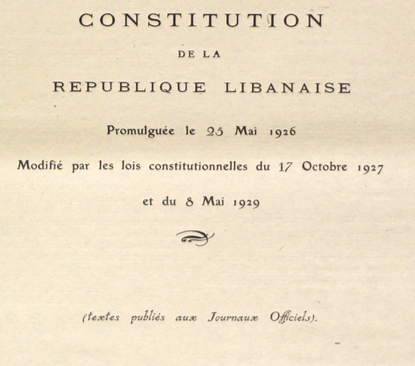
After the French mandate was officially established in 1923, sectarian divisions were reinforced due to the French's favoritism towards Maronite Christians. The 1926 Constitution drafted under the mandate first institutionalized religious representation in government, requiring equitable representation of religious sects without specifying a fixed numerical ratio.
In 1932, a census recorded a slight Christian majority in the country, and this demographic was later used to justify a 6:5 power-sharing ratio formalized in the 1943 National Pact. This arrangement was the foundation of Lebanon’s 1943 independence, which then created the stroke of realpolitik that allowed Christian and Muslim leaders to unite against the French colonial rule by trading their conflicting regional loyalties for a shared, albeit fragile, national sovereignty. The agreement was less of a shared vision for the country, and more of a compromise from both sides on what they agreed to give up to achieve independence. On one hand, the Christians agreed to stop seeking French protection or a permanent Western mandate, and on the other, the Muslims agreed to stop seeking union with Syria or a broader Pan-Arab state, giving up the idea of Lebanon being a province of a larger Islamic or Arab empire.
The resulting compromise was developed through the Taif Agreement in 1989. This treaty was carried out in Saudi Arabia with the goal of ending the Civil War between Lebanese Christians and Lebanese Muslims, establishing coexistence between them, and replacing the Maronite dominance to one of parity.

In order for this agreement to be carried out, Lebanon’s “Arab face” put in place with the National Pact, had to be replaced by the adoption of a new definitive statement “Lebanon is Arab in its identity and in its belonging” in the preamble of the Constitution. By substituting “face” with “identity”, the Lebanese state officially recognised the increased political weight of Muslim confessions and the reality of the post-civil war geopolitical changes. This shift in identity was followed by a total redistribution of governmental power. Originally, under the old pact, the government was characterized by a strong, central Maronite Christian presidency that resembled a near-monarchic authority. Post-Taif, the 6:5 weighted ratio was replaced by a 50/50 allocation of power. Indeed, the presidents’ executive authority was transferred to the Council of Ministers, creating a sectarian troika where power was shared by the three most influential sects in the country. The Sunni Prime Minister would now hold more power in the state’s affairs, and the Shiite Speaker of Parliament would have a more solidified influence. Additionally, parliamentary seats were split evenly between Christian and Muslim, allocating 64 seats for each religion, and further splitting them between denominations depending on their weight of the Lebanese populace in order to create a democracy where no group would be able to outvote another.

Systematic Corruption
Lebanese politics don't revolve around policy platforms and transparent processes, instead decision-making usually occurs through elite bargaining among the most influential sectarian leaders. In fact, political leaders are often the ones distributing jobs, services, and resources to their respective communities in exchange for their loyalty, further proving the point that sectarian allegiance overshadows national identity. These institutional dynamics shape the way Lebanese politics are conducted and foster extensive power of appointment. Consequently, elections are not a genuine reflection of the population’s desire for political change, and weaken accountability, since it is not the state as a whole that is responsible for providing to its people. Moreover, this system unsettles the balance of power in the country, since the same leaders continue to dominate the political scene. The primary failure of this model is that it actively produces and hardens religious motives instead of managing them. In a regular democracy, political parties compete against one another by challenging each other's ideas, whereas in Lebanon said competition is based on communal survival. Because the government is divided into sectarian quotas, specific ministries will become the so-called “property” of its leader’s sect, creating a system that incites citizens to turn to sectarian leaders rather than the state as a whole when in need of provision. Due to the inefficient allocation of resources and services to maintain political support, economic productivity is constrained resulting in corruption, mounting public debt, and deteriorating trust in the state. The weaknesses were the cornerstone of the 2019 economic crisis that saw an eruption of protests all over Lebanon, the collapse of the financial system, and the fall of the Lebanese lira. This declining state capacity was in fact the outcome of institutional dysfunction and governmental mismanagement rooted in the confessional system.

This financial crisis eventually uncovered the corruption of each sectarian power, proving that the economic ruin was not the result of bad luck, but the consequence of a dishonest system where every sect was complicit in theft of public and private resources. Ultimately, it turned out that the Central Bank – along with the commercial banks – had been running a financial Ponzi scheme. For decades, the high interest rates offered by the banks attracted foreign depositors whose dollar deposits were used by the government to fund their prodigious debt. Since the banks were either owned or controlled by sect leaders, these grafts went unnoticed by the public until the collapse of the system. However the failure of this system extends beyond internal mismanagement, striking at the very core of the country’s identity leaving its survival at the mercy of different conflicting religious ideologies.
National Interest
In a confessional state, national interest is fictitious. Since each religion views the identity and the purpose of the country through its own lens, there is no way of agreeing on a shared definition of public good. In Lebanon, religion dictates ideology, while Christians emphasize its historical presence, Muslims stress its identity among the Arab world. This fragmentation directly impacts Lebanon’s foreign policies, with different sects having different alliances across the border. On one hand, Lebanese Muslim parties – specifically the Shia-led coalition – have strong ties with Iran due to its financial and military provision to Hezbollah. On the other hand, Lebanese Christian parties often seek support from Western and Gulf countries such as France, which has strong historical and political ties with Lebanese Christians alongside Saudi Arabia, and Qatar, which supports Lebanese sovereignty and opposes Hezbollah’s alignment with Iran. This situation has turned Lebanon into a playground for foreign influence, functioning as a battleground for regional and international power struggles due to its political landscape being prominently shaped by external factors.
Following the Lebanese civil war, Hezbollah was the only militia allowed to keep its weapons. Because Israel still occupied the south of Lebanon at the time, Hezbollah was characterised as a Resistance group rather than a militia, permitting them to legally keep their arms under the pretext of being the only group capable of liberating the south – since the Lebanese army was too weak to achieve this. In May 2000, Israel withdrew its troops from the country, marking the end of its occupation. It was at that moment that Hezbollah should have handed its weapons to the national army, but instead the non-state army continued operating parallel to the Lebanese Armed Forces. In this environment, Lebanon is ruled by contradictory policies. The current war proves that the confessional system in Lebanon has no means for collective responsibility: when one sect’s ideology inevitably leads the country to war, that sect’s geography becomes ground for destruction and drags unwilling citizens down with it. Because the Shia community is led by Hezbollah, they have adopted a resistance ideology: one not shared by all eighteen sects. Sharing the same interest as Iran, in this context, led to the imposition of Lebanon in a war it did not want to partake in. The consequences of this caused mass destruction in the country, deepening the feeling of resentful division between those who supported the retaliation of Hezbollah and those who feel as if they are paying the price for a war they did not choose.
Other cases
The structural weaknesses observed in a confessional democracy are not unique to Lebanon. Similar dynamics can be observed in other countries such as Iraq and Bosnia, where sectarian quotas also create structural flaws.
The muhasasa ta'ifiya in Iraq is the most similar system to Lebanon’s. Following the US invasion of Iraq in 2003, the Coalition Provisional Authority dissolved the Ba’athist state paving the way for sectarian power-sharing practices. Unofficially, different governmental positions were allocated to different sects with a Kurd as president, Shia as prime minister, and Sunni as speaker of parliament, making it a de facto confessional system. While Lebanon is facing threats of conflict due to the divided interest of the different sects in parliament, the Iraqi government has been taken over by militia-aligned parties that have prevented the full development of a unified economy creating gridlock in the state, and preventing the creation of a unified vision for the country’s future. This is a case of a failed confessional democracy since the state lost its monopoly on force.
In Europe, Bosnia and Herzegovina represents a more severe case of institutional paralysis due to a confessional system. Historically, the country has always existed as a multi-religious entity characterised by a mixture of Muslims (Bosniaks), Orthodox Christians (Serbs), and Catholics (Croats). The 1990s Bosnian war led to the ethnic cleansing of Bosniaks and Croats by Serbs to create homogenous areas. To end the war, the Dayton Agreement was brokered in 1995 successfully halting the conflict, but dividing the country in two: the Federation of Bosnia and Herzegovina and the Republika Srpska. In this system the presidency is attributed to a collective three-member body consisting of one Bosniak, one Croat, and one Serb with a chair rotating every eight months. This system is prone to gridlock because it grants the three constituent blocs veto powers, and makes it mandatory for a law to receive one-third of the votes from representatives of each bloc allowing the delegates from one region to effectively fail any state-wide legislation.
Implications
Challenges are inherent to the confessionalist system. The three countries showcase that institutionalizing identity and structuring power-sharing around religious beliefs has important implications with weakened state capacity.
The consequences are plethoric, but the most immediate one is political paralysis. In Lebanon, because the Council of Ministers operate on the basis of a sectarian consensus, decision making becomes inevitably harder due to a lengthier and slower process. In a country where the government is characterized by power-hungry leaders, this results in disagreements between political actors leading to year-long governmental vacuums. In 2022, following the end of Michel Aoun’s presidency, the country endured an almost 3 year long vacancy. The gridlock occurred because no single political bloc held enough seats to elect a successor on their own, and rival factions could not agree on a consensus candidate. To elect a president, two-thirds of the 128 MPs must be present for a session. In many of the 12 failed attempts before the final vote, some blocs walked out after the first round of voting to break the quorum. Finally, in 2025, with a majority of 99 votes, Joseph Aoun was elected president ending the three year long crisis. During the gap between the two presidents, since no single person had power over the others, state capacity weakened further, and urgent reforms were delayed. This creates a cycle of policy failures and inefficient governmental structure.

During times of regional crisis, the Lebanese democracy has brought to light the conflict of interest between its top leaders. The current war has shown friction between the ideologies of Prime Minister Nawaf Salam and Parliament Speaker Nabih Berri. Salam, on one hand, has prioritised the safety of the Lebanese population, calling for a ceasefire, and eventual peace talks. While Berri, on the other, has held opposite opinions, aligning himself behind Hezbollah. This situation makes it harder for negotiations to take place, since no single authority can guarantee the country’s commitment. Because authority is divided along sectarian lines, each leader has the incentive to prioritize and promote the interest of his community rather than work on an arrangement that benefits the nation as a whole. This creates coordination problems within the Lebanese government, prohibiting the state from acting cohesively, resulting in unconsolidated negotiations, and a more fragile and weak representation of the country on the global stage.
The long-term implications of this model can affect both the structure of the government and the citizens of the state. In terms of institutional structure, sectarian identity becomes entrenched into the government, consolidating elite power. By creating a dependence between religious affiliation and political power, the system encourages the institutionalisation of sectarian belonging, and discourages independent political reasoning, strengthening alignment with sectarian leadership. This incentivises citizens to act as members of their respective community, rather than members of a unified state. This dynamic is linked to the fact that the confessional system rewards loyalty to the elites over independent judgement. In addition, established leaders don’t face much competition allowing them to stay in power for extended periods, creating somewhat of a monopoly of leadership that sustains their authority.
This cartel-like system has profound consequences on the populace, specifically in shaping political engagement. Given that the political structure prioritizes sectarian interest rather than national interest, public trust in the government and institutions weakens, eroding the legitimacy of the already fragile system. In this situation, political participation becomes obsolete, and loses its meaning as elections seem to produce the same outcome repeatedly, instead of challenging the existing leadership. This cynicism is profound in younger generations who face limited opportunities due to government lockdowns which paralyze the country as a whole, and lower possibility of social mobility. As a result, emigration increases, depriving the country from human capital, and further reducing its chances at potential development.
Alternatives
While many alternatives could theoretically be considered solutions to the limitations of confessional democracy, not all of them are feasible, especially in the case of Lebanon.
The most straight-forward reform would be to dismantle confessionalism as a whole, and replace it with a non-sectarian system that favors policy instead of religious identity. Hypothetically, a transition to a real democratic system would strengthen engagement in civil life and transparency, and enhance national unity along with decision-making. However, this replacement faces many limitations, and would realistically not work out. In a religiously diverse country like Lebanon, removing guaranteed representation from the political scene risks the marginalisation of certain ethnic and religious groups potentially triggering conflict. Confessionalism, despite its inefficiencies, guarantees the protection of all different groups, providing somewhat of a reassurance to minorities. Therefore, the abrupt removal of such a system would destabilise society. To make de-sectarianisation more realistic, a gradual approach to a fully democratic system would be more viable. In this case, sectarian quotas would be reduced progressively allowing the population to adapt and adjust to the new system accordingly. To guarantee the representation of minorities, such a reform could be combined with the introduction of a bicameral legislature, in which a chamber would serve the purpose of representing citizens and balancing the power between religious majorities and minorities, while the other would work towards safeguarding communal interests with the goal of building a cohesive and efficient political system.
Another reform that could be considered would be to replace the long-standing elites who have continuously dominated the political scene in Lebanon. As the decades have revealed, the dominance of these leaders has produced corruption and duplicity in turn, giving people hope that real change can only happen through governmental renewal. Although confessionalism in itself encourages and facilitates the reproduction of elites and patronage, new leaders could potentially disrupt the current networks, and bring new perspectives to the government. This option faces constraints, due to the lack of resources and backing of new candidates making it harder for them to make a name for themselves, find support, and position themselves at the heart of the Lebanese government. Therefore, electoral turnover is difficult and inefficient without structural changes to the underlying system.
Conclusion
Lebanon’s case forces a reconsideration of what it means for a political system to truly be democratic. Even though a confessional democracy still provides fundamental freedoms, and protects human rights, at its core it's an inefficient form of government that protects diversity while compromising effective governance and national interest. By combining political life and religious affiliation, this type of system limits the emergence of a unified nation, and instead produces political paralysis and constant dysfunction. This does not imply that alternatives would necessarily be quick fixes, indeed in this case, replacing this system carries costs: the challenge thus lies in the reframing of the structure and institutions, along with balancing the representation of citizens and ethical leadership.
Bibliography
Alibašić, A. (2020, December 11). History of Inter-Religious Dialogue in Bosnia and Herzegovina. ScienceDirect.
Butler, S. (2026, April 2). Nabih Berri’s veto has side-lined the Lebanese state. The Arab Weekly.
Dodge, T. (2024, September). Managing Religious Diversity in the Middle East: The Muhasasa Ta'ifia in Iraq, 2003–2018. LSE.
Fehmi, J. (2026, March 27). War in Lebanon 'was imposed upon us', PM Nawaf Salam says. France 24.
Gritten, D. (2025, January 9). Army chief elected Lebanon's president after years of deadlock. BBC.
Jadah, M. (2026, April 8). As Berri reconciles with Hezbollah, Israel opens fire on Amal. L’Orient Today.
Gebeily, M. (2025, December 3). Lebanon PM says peace with Israel could bring economic ties, but both far off. Reuters.
Makdisi, S & Amine, R. (2022, August). Lebanon’s Multifaceted Economic Crisis of October 2019: Causes, RepercussionsA Diagnosis. ERF Working Papers Series.
Mathieu, M. (2024, March 1). The role of ethno-confessional factors and their impact on Iraqi instability from 2003 to the present day. EISMENA.
Travers, E. (2024, October 1). Explainer: What is Security Council resolution 1701?. United Nations.
World Bank Group. (2022, August 22). Lebanon’s Ponzi Finance Scheme Has Caused Unprecedented Social and Economic Pain to the Lebanese People. World Bank.


Comments