


Labour, Capital and the Machinery of Exploitation

Europe’s contemporary migration landscape represents a complex problem that is shaped by both humanitarian necessity and economic design. While public discourse around migration is centered around cultural influence, security issues, and broader questions of social cohesion, its most important consequences are structural. The issue is far from just the movement of people, but it is about how this movement is absorbed into labour markets that are already unequal and institutionally segmented.
Migration does not enter within a vacuum. It enters economies with varying levels of wage setting, different housing capacities, and unique political traditions. As a result, the outcome of migration is never uniform. In some cases, migration becomes one of the most useful tools in immediately filling crucial labour shortages in key sectors that strengthen long-term growth. In others, especially where workers already operate under precarious legal and social conditions, it expands into what Karl Marx called the “industrial reserve force”: a labour force whose vulnerability within the broader socioeconomic conditions can help restrain domestic wage growth and weaken labour’s bargaining power to sustain capital accumulation.
This can be understood in a more practical sense through the divide between workers who remain protected by contracts, collective bargaining agreements, and social rights, and those who are left at the margins in more insecure forms of employment. Migration, when absorbed under precarious conditions, often enlarges the latter. That makes it easier for firms to preserve stability in some parts of the labour market while pushing flexibility and competitive pressure downward onto subsections of the labour market that are less protected.
When workers are admitted into labour markets while denied stable protections, equal mobility, or meaningful bargaining power, migration can become part of a broader system in which flexibility for employers is purchased through insecurity for labourers. The important question is not whether Europe should have migration, but what kind of labour regime migration is aimed to serve.
Impact of immigration on the labour market
Across the European Union, the impact of migration on wages is heterogeneous. It varies across different parameters, ranging from skill levels to the institutional settings under which each sector operates. Aggregate studies by the OECD and the European Commission have repeatedly shown that immigration tends to have only a marginal effect on wages, but the underlying distribution provides interesting insight. The gains and losses resulting from immigration are far from equal, with certain groups of the labour market reaping the benefits of increased complementarity while others face direct competition.
This division is especially noticeable when we draw a comparison across different skill levels of workers. At the higher end, migrants entering the labour market through sectors such as technology and other professional services tend to fill genuine shortages. In such cases, firms see a rise in productivity levels and overall output as it allows native workers to specialise. Their entry into the market is contingent on occupational niches that best sustain macroeconomic output.
At the lower end, this distribution looks very different. These migrants are frequently absorbed into sectors, such as agriculture, construction, hospitality, and domestic work, with higher turnover rates that indicate a higher frequency of temporary unemployment and weaker enforcement capacity.
These are sectors where the legal floor for employee safety is weak, and its enforcement is even weaker. Workers in these sectors often do not fall under the coverage of collective bargaining agreements, do not have a formal union presence, and have opaque subcontracting chains. Immigration in these situations simply acts as competition.

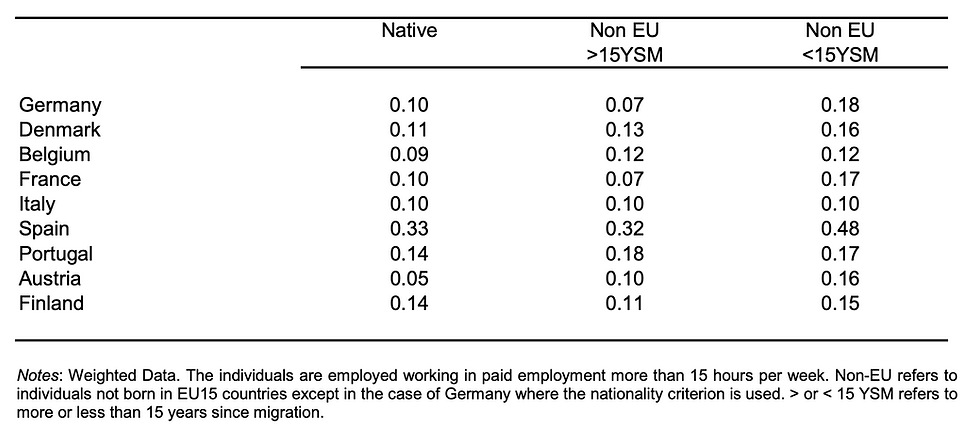
It is important to note that this precariousness in the workforce is not confined to just migrants or irregular workers alone. Over the last few decades, and especially during the eurosclerosis phase (1970s-1980s) of economic stagnation with mass levels of unemployment, the neoliberal critique of these issues was rooted in the lack of flexibility for labour and, subsequently, the firms that fired them. Since then, major reforms took place to increase this “flexibility” by introducing newer forms of temporary contracts and reducing the costs of hiring and dismissing workers on the margin. These reforms that persisted across Europe, but most notably in Spain and Italy, had deepened the labour market dualisation that had already existed by not uniformly increasing this flexibility across different types of labour contracts.
This shortcoming is evident in Spain’s era of “neoliberal reforms”, beginning early in 1984, when the Spanish government first introduced reforms to dismissal costs through the employee protection contract (EPC). Since an across-the-board reduction of dismissal costs was politically impossible, the reform liberalized only the use of temporary contracts. When terminated at term, temporary contracts required lower severance payments than permanent contracts. In particular, temporary workers were entitled to 12 days per year of seniority based on the salary, and this could not be appealed in labour courts. As a result, temporary employment increased from around 10% in the mid-eighties to more than 30% in the early nineties. Similar reforms took place in Italy, first through the Pacchetto Treu reforms in 1997 and accelerated in the Berlusconi era, most notably through the Biagi Law in 2003. The Treu package introduced temporary agency work, restructured training contracts, and made part-time work more flexible, while the Biagi law added new atypical forms such as employee leasing, on-call work, and job sharing.
While short-term improvements were seen in both countries, as atypical work continued to expand, these flexibilisation policies did not improve labor conditions. Lacking the required institutional and legal protection, migration is then inserted into this already existing, fragile structure. Migrants frequently enter through precisely these insecure channels, which means their vulnerability is not separate from the labour market’s broader organisation but part of an enlarged zone of flexibility that employers can use to lower costs and weaken labour’s collective position.
This is why the effects of migration are not evenly distributed across the working class in itself. Workers who are already embedded in stronger contractual and institutionalized sectors are relatively more protected when compared to other migrant and low-wage domestic workers, who are instead clustered in temporary and less protected sectors that absorb pressure.
Empirical research in Europe strongly supports this institutional reading. The European Parliament's work has shown that migrants remain disproportionately concentrated in low-paid, temporary, and part-time employment, and are more likely to experience skill downgrading. Many of these migrants work below their formal level of qualification as they are limited by both a lack of mobility and a lack of bargaining power. The IMF has reached a similar conclusion in noting that migrant wage gaps narrow more quickly in countries with stronger labour-market institutions and more effective enforcement.
A labour market with high substitutability and weak protection with poor enforcement is much more likely to turn migration into a source of wage discipline. However, a labour market with stronger protection is more likely to turn migration into complementarity and productivity gains. The same inflow of labour can therefore produce very different social outcomes.
Germany is often cited as an example of the same. Research by Ottaviano and Peri found relatively limited wage displacement because native and migrant workers frequently specialised in different tasks. Migrants were more concentrated in routine and manual work, while natives were concentrated in communication-intensive roles. In this setting, immigration led to less direct displacement and allowed for relocation within the labour market. Complementarity at one level can coexist with dualism at another, especially where less protected workers are concentrated in more insecure forms of employment. This is why broad claims that immigration always leads to a loss in jobs are analytically weak. Labour markets are structured, not flat.
Fiscal and macroeconomic considerations
Another common worry about migration is the fiscal constraint. A common political claim is that migrants impose unsustainable costs on the welfare system and public budgets. This argument lies at the core of many anti-immigration narratives, but the evidence behind the same is much more mixed and far less dramatic than public rhetoric suggests.
The European Commission’s Knowledge4Policy platform, along with a large body of comparative research, finds that the net fiscal impact of migration is generally small. Migrants tend to contribute roughly as much in taxes and social contributions as they receive in benefits over time. This varies substantially by age, employment rate, and skill profile. Younger and prime-age migrants who enter employment relatively quickly are often fiscally positive, particularly in ageing societies where labour-force participation matters more and more for sustaining tax bases and pension systems.
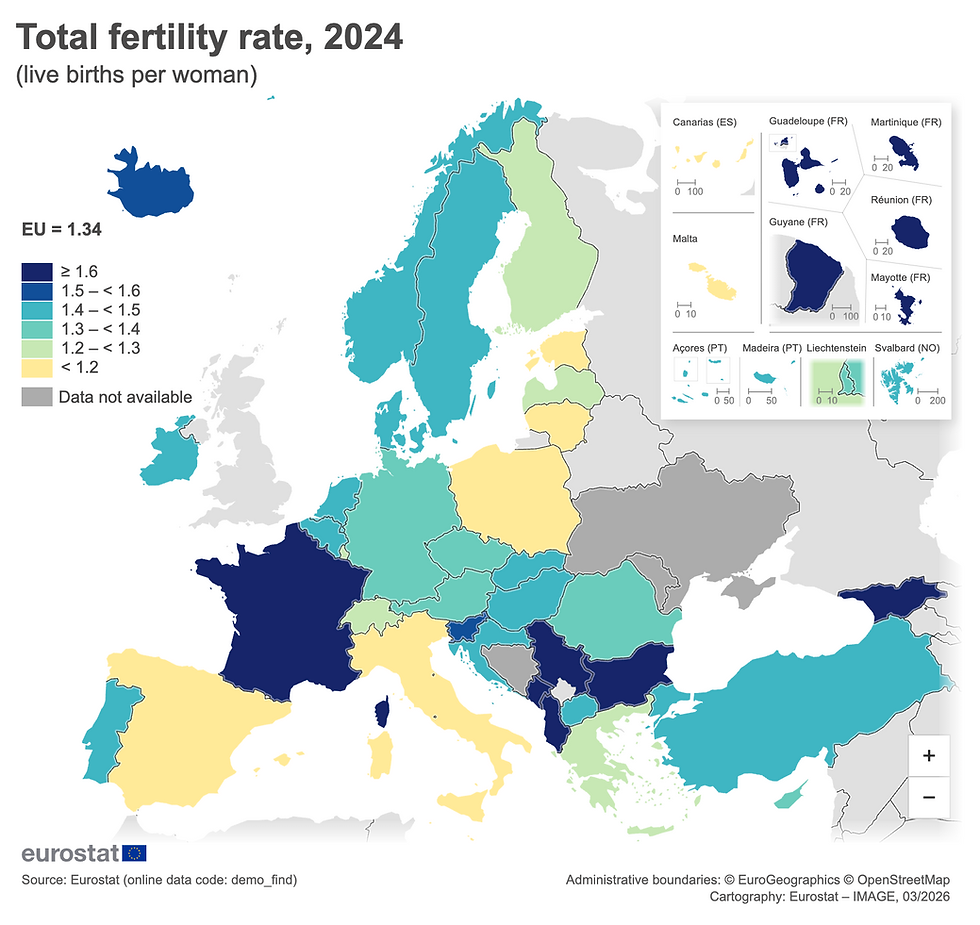
This is especially relevant in the European context, which is suffering from a rapidly aging demographic. Fertility rates remain well below the replacement level across the continent, and the working-age share of the population continues to shrink. Migration in such a setting can act as a demographic stabiliser by helping offset labour shortages and sustain domestic aggregate demand. They also become a useful part of the tax payers that are vital in sustaining the pension system.
Recent macroeconomic evidence supports this point. Non-EU citizens accounted for a very large share of new employment created in the European Union in the years following the pandemic, even as unemployment among EU nationals remained relatively low. This matters because it directly challenges the idea that migrant workers simply displace domestic labour on a one-for-one basis. In many cases, migrants are filling gaps in labour demand that domestic labour supply is no longer sufficient to meet.
While the numbers themselves show a compelling case, the question also lies with the direction of economic transition that countries want to take. The broader plans for Europe's growth involve green transition, digital transformation, and care sectors that all require specialised labour. These are no longer abstract future needs but are required for immediate structural constraints. Foreign labour has proven to support potential output and labour-force growth, helping cushion the macroeconomic consequences of population ageing.
The short-term costs of migration lie mainly in reception systems, housing, schooling, and other integration systems. While there are visible inflationary pressures from this influx of people, the issue lies in the state's inability to plan and provide the right institutional conditions to facilitate the same.
The fiscal debate centered around migration is thus not arguing against migration, but against incorporating migration into European economies without the infrastructure to manage it fairly.
Structural exploitation and the role of capital
Beneath Europe’s formal labour market framework, there exists a segmented and dualised labour market where migrants, especially those with irregular or insecure status, disproportionately represent those who work in the most vulnerable end of production. This legal precarity has great economic value for firms and is the core mechanism that allows for the exploitation of migrant labour.
Workers who have legal precarity of their residence conditions and lack access to mobility tend to hold weak bargaining positions and struggle to organise and engage in typical activities that labour must perform to secure its rights. This inherent disadvantage allows firms to underpay them as the employee’s dependence on the employer goes up when they lack practical access to legal protections. As such, even when labour rights formally exist, they become practically inaccessible. This allows employers to extract more from labour while externalising the social cost of insecurity onto other workers and the broader public systems that they are a part of.
This dynamic becomes clear when viewed within the broader spread of atypical work. The most vulnerable workers are not just those who are formally employed outside the labour market, but also include those who exist within the labour market but under insecure conditions, such as temporary hires, fixed-term workers, subcontracted workers, and, in this case, migrants tied to unstable arrangements. In this sense, precarious migrant labour is not an exception to the labour market; it is an intensified version of a wider trend. Employers benefit from this because it fragments labour. It becomes harder for the workforce to act collectively when one segment remains relatively protected while another is structurally disposable. The vulnerability of migrant labour not only affects their own bargaining position but can more broadly weaken a certain stratum of labour’s position.
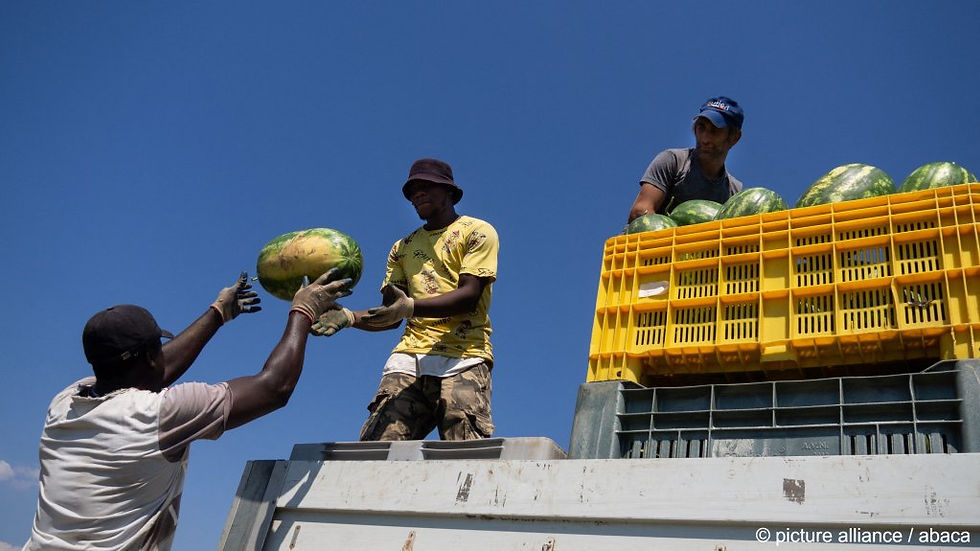
The agriculture industry is one such example where exploitation is embedded in the production process. Oxfam’s work on Europe’s agri-food states that migrant labour lies at the heart of the low-cost food production industry, with 25% of agricultural workers in Europe being migrants. In the countries that they surveyed, migrant workers were frequently found earning below the statutory minimum wage. There was a broad difference in genders across this exploitation, as women suffered sharper disadvantages in terms of pay and effective protection.
While the agriculture sector is repeatedly associated with long hours and high informal dependencies that have limited access to legal remedies, similar patterns are seen across multiple other industries. The European Parliament’s work on labour exploitation has identified fisheries, construction, food processing, and hospitality as some of the industries that are especially exposed to abuse, particularly where irregular migration, weak inspection, and layered subcontracting structures intersect. The more labour is mediated through labour contractors, temporary agencies, and other ambiguous legal categories, the easier it becomes to reject accountability while preserving the economic gains that vulnerability makes possible.
Investigations supported by the International Transport Workers’ Federation into the UK fishing sector showed how employers used seafarers’ transit visas to recruit migrant crews under conditions that left them acutely vulnerable. Surveyed workers reported long shifts with widespread fear of getting blacklisted. The average hourly earnings were also far below the legal minimum. Putting aside the severity of abuse, this exploitation depended on a legally tolerated channel through which vulnerability could be normalised and managed. This is precisely how precarious migration becomes economically useful: not outside the law altogether, but often through grey zones in which labour can be kept cheap, dependent, and difficult to protect.

From this perspective, migration becomes economically functional in two senses at once. First, it supplies needed labour to sectors facing shortages. Second, when migrants are incorporated precariously, it supplies labour in a form that is easier to discipline. That is what makes precarious migration so useful to capital. It produces labour flexibility not through technological change or productivity gains alone but through differentiated rights, weak bargaining power, and the constant threat of replacement.
Conclusion
Migration is not an anomaly of Europe’s economy; it is an enduring feature of it. The real issue is not whether migration exists, but how it is governed and incorporated. The European example shows us that it has less to do with the number of migrants and more to do with the institutional arrangements that shape it.
When migrants are incorporated as right-bearing workers with enforceable protections and a decent material standard of living within the labour market, they can contribute to a stable and high rate of economic growth by filling key technical niches that are missing, while also ensuring that the demographic decline does not have a massive economic impact. In those conditions, migration helps strengthen the existing social order.
Instead, when they are admitted as a precarious labour reserve, they are key in deepening the labour market dualisation by further hampering the bargaining conditions of this “outsider” group. There is also a social fracture within broader society as material standards become worse, with little to no pathways for them to fully integrate and assimilate into society. The role of migration is no longer economic stabilisation; it remains simply to help industries that only function with a labour market regime whose redeeming characteristic is cheap labour with weak bargaining power.
That is why Europe’s migration question is fundamentally a question about political economy. It is about whether movements across borders will be governed through equalisation or through precarity. It is about whether migrants will be integrated into the same institutional protections that sustain the rest of the workforce, or used to bypass them. More importantly, it is whether the tensions that this exploitation generates are dealt with through structural policy reforms, or whether this is simply recoded as a cultural conflict.
Europe’s future prosperity depends not on curtailing mobility as such, but on ensuring that mobility does not become a mechanism through which labour is made cheaper. In that sense, the issue is not simply migration. It is the machinery into which migration is inserted. And today, too often, that machinery still works in favour of capital over labour: where profit remains privatised while the cost of adjustment is socialised.
Bibliography
European Central Bank. (2025, May 8). Foreign workers: A lever for economic growth. https://www.ecb.europa.eu/press/blog/date/2025/html/ecb.blog20250508~897078ce87.en.html
European Parliament. (2024, December 11). New approaches to labour market integration of migrants and refugees. https://www.europarl.europa.eu/thinktank/en/document/IPOL_STU%282024%29754232
European Union Agency for Fundamental Rights. (n.d.). Trafficking and labour exploitation. https://fra.europa.eu/en/themes/trafficking-and-labour-exploitation
Gnocato, N., Modena, F., & Tomasi, C. (2020). Labor market reforms and allocative efficiency in Italy. Labour Economics, 67, Article 101938. https://doi.org/10.1016/j.labeco.2020.101938
International Transport Workers’ Federation. (2023, June 16). Migrant labour exploitation, abuse remain rife in UK fishing industry – FT exposé. https://www.itfglobal.org/en/news/migrant-labour-exploitation-abuse-remain-rife-in-uk-fishing-industry-ft-expose
Keune, M. (2015). Trade unions, precarious work and dualisation in Europe. In W. Eichhorst & P. Marx (Eds.), Non-standard employment in post-industrial labour markets (pp. 378–400). Edward Elgar Publishing. https://doi.org/10.4337/9781781001721.00021
OECD. (n.d.). Overview data on migration flows and migrant populations [Data set]. https://www.oecd.org/en/data/datasets/overview-data-on-migration-flows-and-migrant-populations.htm
Oxfam International. (2024, June 4). Millions of migrant farm workers exploited in Europe’s fields, says Oxfam. https://www.oxfam.org/en/press-releases/millions-migrant-farm-workers-exploited-europes-fields-says-oxfam
Polavieja, J. G. (2003). Temporary contracts and labour market segmentation in Spain: An employment-rent approach. European Sociological Review, 19(5), 501–517. https://www.jstor.org/stable/3559537
OECD. (2007, June 11). Integration of immigrants in OECD countries https://www.oecd.org/en/publications/integration-of-immigrants-in-oecd-countries_162367775052.html


Comments