


Brief | Strait Back to Business

The Iran conflict was supposed to be a deathblow to Chinese energy. It instead revealed a couple aces up Xi's sleeve–though a long war could crack Xi's aces.
On February 28, the United States and Israel began launching attacks on Iran in what many hoped would be a brief conflict not unlike the Twelve-Day War. That assumption collapsed almost immediately. Iran retaliated by attacking U.S. bases in the Gulf, targeting energy infrastructure, and, most consequentially, blockading the Strait of Hormuz–the chokepoint through which roughly 20% of global crude oil and 20% of LNG exports had previously passed. Asia was the most exposed: more than half of the LNG and nearly 90 % of the crude moving through Hormuz was bound for Asian buyers, China being the most prominent. As the war dragged on far beyond initial expectations and Gulf exports slowed almost to a standstill, governments across East Asia began preparing to curb oil use. China largely did not. Why?

The Elephant in the Room
The Gulf, and Iran within it, are central to Chinese energy security in both oil and gas. China produces only around 26% of the oil it consumes domestically, and that share is likely at its peak. In 2025, China imported 42% of its crude from Saudi Arabia, Iraq, the UAE, Oman, Kuwait, and Qatar. Customs data record no Iranian crude, but tanker tracking by commodity analysts Kpler suggests China still imported roughly 12% of total crude imports from Iran in 2025. Although suppliers are geographically varied, ranging from Angola to Brazil to Russia, 90% of oil imports arrive by sea, leaving China exposed to maritime trade disruptions.
On the other hand, China produces 57% of its gas domestically, and unlike in Europe–where residential heating creates acute seasonal vulnerability–Chinese gas consumption is heavily weighted toward industrial applications, such as fertilizer production. China still imports nearly one-third of its LNG from the Middle East, meaning a disruption to the Strait of Hormuz does create pressure on industrial supply chains–but the absence of household heating dependency limits the immediate political fallout of a supply shock.
How to Cope
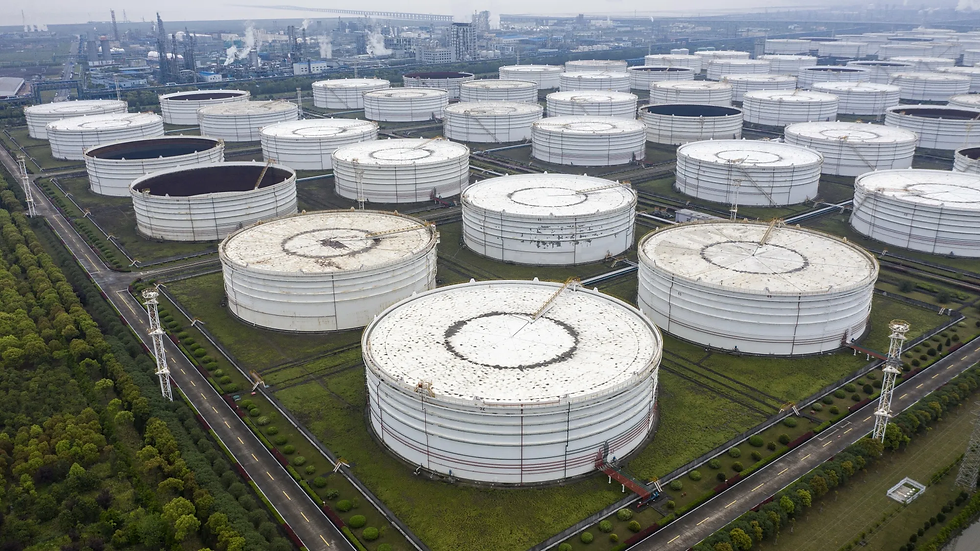
Beijing's answer to these vulnerabilities for decades has been to build buffers, above all in oil. China launched its strategic petroleum reserve program in the early 2000s, began constructing the first SPR sites in 2004, and by 2007 had formalized a two-tier system of state and commercial reserves. Beijing then formalized the 2019–2025 Seven-Year Action Plan for oil and gas development, which helped push domestic crude production close to its peak in 2024. Stockpiling has also been relentless, with 86% of oil import growth between 2024 and 2025 going into storage. Columbia's Center on Global Energy Policy estimates that, as of early March 2026, China held approximately 1.39 billion barrels across state and commercial storage, enough to cover roughly 120 days of crude imports at 2025 rates. Given that oil accounts for 20% of China's primary energy consumption against 9% for natural gas, this focus on oil stockpiles appears justified. Gas storage remains a conspicuous weak point with working storage in 2024 covering just 6.3% of annual consumption, a fraction of the 25% buffer maintained across much of Europe. That gap matters less than it would in a European context, given the industrial rather than residential nature of Chinese gas demand, but it remains a vulnerability.
The solution to the broader energy dilemma is not clean, however, as coal remains the backbone of the system. It still accounted for approximately 55% of China's primary energy consumption in 2025, giving Beijing a domestic fallback that few other major importers possess. Beijing has paired this structural anchor with an aggressive revamping of the power sector. Clean energy rose from 10.9% to 26.4% of China's total energy use between 2013 and 2023. In 2024, China added 373 gigawatts of renewable capacity, pushing total renewable capacity to 1,889 gigawatts - 56% of all installed power capacity. By mid 2025, operational and under-construction nuclear power capacity had exceeded 100 gigawatts, and in April 2025, the State Council approved 10 new reactors with planned investment of more than 200 billion yuan. Batteries are expanding just as aggressively, with new-type energy storage reaching 74 GW by the end of 2024 against a 2027 target of more than 180 gigawatts. The rationale is to preserve coal as a domestic security anchor in the near term while steadily expanding the share of energy that requires no imported oil or gas. So far, however, this buildout has largely run alongside demand rather than displacing it. China's total energy consumption has grown fast enough that renewables have expanded the overall mix without yet shrinking the absolute role of fossil fuels. With the growing adoption of NEVs and LNG-powered trucks, demand for gasoline and diesel is already applying downward pressure to oil imports. As China's economy matures, its most energy-intensive industrial phase draws to a close, and as total population declines, oil demand is expected to peak in 2027. As demand for oil declines, the renewable and nuclear capacity in place will start displacing the fossil fuels in the energy system. In the long run, that could produce real energy independence, removing a crucial thorn from China's great power ambitions.

Rocky Waters Ahead
For all the sophistication of China's energy preparations, the diplomatic dimension of this strategy remains brittle. While geopolitical pressure mounts, Chinese energy diplomacy has repeatedly shown a surprising inability to leverage its economic weight. Chinese state companies routinely shun Russian crude when secondary sanctions risk becomes too visible, despite Beijing's official strategic partnership with Moscow. Venezuela, once a significant supplier and recipient of tens of billions in Chinese loans, was effectively left to collapse under U.S. pressure. Now Iran, where Chinese leverage is most extensive, is proving equally resistant to direction. Chinese oil purchases fund an estimated 45% of the Iranian state budget, bilateral trade reached 42 billion dollars in 2025, and Beijing provides much of the financial and logistical architecture through which Iran circumvents Western sanctions, with over 80% of Iranian oil exports flowing to China alone. Yet Tehran has not been able to ensure the free passage of Chinese vessels through the Strait of Hormuz over most of the duration of this conflict to date.

The deepest vulnerability in China's energy position is its lack of military reach. American naval presence across the Gulf, the Indian Ocean, and the Western Pacific gives Washington the ability to protect, threaten, or interdict the sea lanes on which the global oil system depends. China has no equivalent. The Hormuz blockade is a reminder that the Strait of Malacca, through which approximately 23.2 million barrels per day flow and where the U.S. Navy operates with far greater freedom than in the Gulf, represents an even more acute version of the same threat. Until China can credibly contest control of the sea lanes on which its economy depends, its energy security rests on US interests and the rationality of its administration.

A Lesson to Learn
The Iran conflict has laid bare both the strength and the limits of China's energy security architecture. The combination of a coal backstop, growing oil reserves, rapid renewable expansion, and a deliberately diversified supply network represents a generational effort to address the central vulnerability that has shadowed China's rise as an industrial power. The problem is that, until the plan reaches completion, China remains exposed to the kind of near- and medium-term shocks that a blockade, a prolonged war, or a hostile chokepoint disruption can deliver with little warning. What the current conflict has revealed most starkly is not a gap in stockpiles, but one in influence: Beijing cannot coordinate effectively with strategic partners when their interests diverge, and it has no military instrument to enforce its will when diplomacy fails. Until China can credibly contest control of the sea lanes on which its economy depends on, true energy independence remains out of reach.
Europe should read all of this as a lesson in what serious energy security planning actually looks like: a long-term endeavor requiring substantial investments, foresight and compromises. China’s pragmatism shows how energy should be treated as a matter of state strategy rather than pure market efficiency. The gas crisis of 2022 was a first taste of what that means in practice. China cannot eliminate its vulnerability, but it has shown what it looks like to take the problem seriously. That is the lesson worth learning.
Bibliography
Amid regional conflict, the strait of Hormuz remains critical oil chokepoint . EIA. (2025a, June 16). https://www.eia.gov/todayinenergy/detail.php?id=65504
Ayres, G., Burton, R., Federici, J., Morget, N., & Tsering, L. (2026, March 16). China-iran fact sheet: A short primer on the relationship. United States–China Economic and Security Review Commission. https://www.uscc.gov/sites/default/files/2026-03/China Iran_Fact_Sheet_A_Short_Primer_on_the_Relationship.pdf
China Country Analysis Brief last updated: May 2025. EIA. (2025b, May). https://www.eia.gov/international/content/analysis/countries_long/China/pdf/China 2025.pdf
Corbeau, A.-S., & Downs, E. (2025, June 26). What the conflict in the Middle East means for China’s natural gas supply security. Center on Global Energy Policy at Columbia University SIPA | CGEP. https://www.energypolicy.columbia.edu/what-the-conflict-in the-middle-east-means-for-chinas-natural-gas-supply-security/
Downs, E. (2025, April 30). China’s oil demand, imports and supply security. Center on Global Energy Policy at Columbia University SIPA | CGEP.
Downs, E. (2026, March 4). Implications of the conflict in the Middle East for China’s energy security. Center on Global Energy Policy at Columbia University SIPA | CGEP. https://www.energypolicy.columbia.edu/implications-of-the-conflict-in-the-middle-east for-chinas-energy-security/
Liang, C. (2025, March 5). China prioritizes gas infrastructure expansion in 2025 amid storage challenges. S&P Global Energy. https://www.spglobal.com/energy/en/news-research/latest-news/lng/030525-china-prioritizes-gas-infrastructure-expansion-in-2025- amid-storage-challenges
Maguire, G. (2025, October 25). Charting China’s evolving primary energy mix through 2060. Reuters. https://www.reuters.com/business/energy/charting-chinas-evolving-primary energy-mix-through-2060-2025-10-28/
Mukherji, B. (2026, April 14). Asia’s energy supply at Breaking Point as US blockades Hormuz. South China Morning Post. https://www.scmp.com/week asia/economics/article/3350057/asias-energy-supply-breaking-point-us-blockades hormuz
Russell, C. (2026, April 16). China added more crude to its massive stockpile in March, but outlook shifts. Reuters. https://www.reuters.com/markets/commodities/china-added more-crude-its-massive-stockpile-march-outlook-shifts-2026-04-16/


Comments