


Brief | From Brussels to Brasília

Trade used as geopolitical leverage in the EU-Mercosur agreement
Following twenty-five years of negotiations, the controversial EU-Mercosur Partnership Agreement (EMPA) was finally signed in Paraguay on January 17. As stated by President von der Leyen, the trade deal aims to establish one of the largest free trade areas in the world, as well as demonstrate and reinforce the union’s stance “for openness, for cooperation and for mutual gain” in today’s tense geopolitical environment. Thus, it is imperative that the power-shifting consequences of this deal both within the EU and globally are acknowledged.

Negotiations regarding the EU’s agreement with the South American trade bloc (including Brazil, Argentina, Paraguay and Uruguay) began in 2000, with the aim of promoting European leadership and firmly establishing rules regarding global trade. The finalized megadeal, which will take effect if approved as compatible with EU treaties by the Union’s Court of Justice, contains several measures designed to facilitate trade between the two blocs. Particularly, the EMPA is structured around two main pillars: political and regulatory cooperation, as well as market access and investment liberalization. In other words, almost all tariffs will be gradually eliminated, boosting EU exports mainly of machinery, transport equipment, and pharmaceutical products and increasing imports of pulp, paper, minerals, and agricultural products. The EMPA is expected to generate economic gains for European firms in several sectors, as it would increase their access to approximately 780 million overseas consumers by eliminating tariffs on goods currently facing high barriers in Mercosur countries. Specifically, according to economists’ estimations, the agreement will boost the GDP of Mercosur nations by 0.7% and of European nations by 0.1% by 2040.

Yet, the geopolitical benefits of the agreement are widely believed to be much greater, especially by European proponents of the deal. The change in US foreign policy under the Trump administration has placed Europe in an increasingly antagonistic position with both the US and China. Especially after the US military operation to capture Venezuela’s Maduro, the US has demonstrated its explicit involvement in South American affairs, while China has drawn Brazil away from Western influence through the BRICS grouping. The EU-Mercosur deal, however, will likely improve the Union's strategic position, as it will expand its trade network to 97% of Latin America’s economy, a far greater share compared to the 44% held by the US and the 14% held by China. Thus, through the EMPA, the EU hopes to prove its reliability as a credible alternative to the two major global economies, a crucial attribute especially following the arrest of Maduro. This became increasingly clear through von der Leyen’s statement, in which she emphasized, “We choose fair trade over tariffs, we choose a productive, long-term partnership”. Some believe that this megadeal, along with agreements previously stalled over climate concerns or agricultural standards, signals the Union’s attempt to diversify its trading partners at a time of uncertainty.

Furthermore, the EMPA is expected to grant Europe easier access to Argentina’s and Brazil’s vast mineral reserves of lithium, manganese, aluminium, graphite, tantalum, and niobium. These minerals have been deemed crucial for the continent’s future, particularly because they play a key role in the EU’s digital and environmental transition plans. As a result, Brussels’ dependence on China to build weapons and power green energy will likely be greatly reduced. However, increased mineral extraction and mining would equate to increased Amazon deforestation. The Amazon rainforest would also further suffer through land conversion into pasture to aid the potential increase in Mercosur beef exports, something that has led to environmentalists’ opposition to the deal. In an effort to account for that, the EMPA ensures signatories’ commitment to the Paris Climate Agreement, while also including mandatory safeguards against illegal deforestation. Generally, the effect that the deal will have on the environment is still being debated, as some argue that it “goes against the EU’s [climate] commitments” and will result in increased carbon emissions, the erosion of biodiversity, and the trade of harmful pesticides. Others claim that the Union’s sustainability push will have a positive environmental effect, supplementing Argentina’s and Uruguay’s development of new bioeconomy strategies.
Other than shifting the EU’s geopolitical position, the trade agreement has created tensions across different sectors within the Union, mobilizing both those who stand to benefit and those who stand to lose, exerting domestic political pressure on their respective leaders. Thus, the megadeal has already significantly impacted power dynamics internally, resulting in certain leaders expanding their political capital, whereas others suffer harsh criticism.

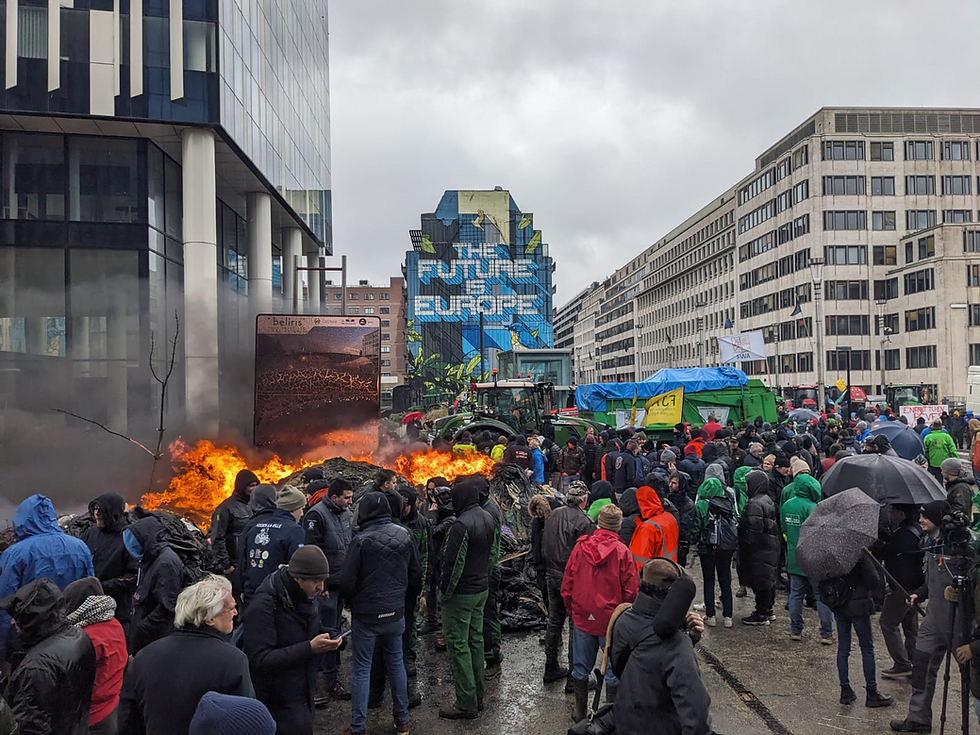
The person seemingly most impacted by his failure to block the deal is French President Emmanuel Macron, disappointing the "unanimous political rejection" of the EMPA across the country’s political spectrum. As the EU’s leading agricultural power, France has its concerns over the Mercosur countries’ export potential in this particular sector. The main sources of worry include unfair competition for European farmers as a result of lower agrifood standards and lower-cost, large-scale production in the Latin American region. The highly sensitive agrifood industry in Europe pushed Poland, Austria, Ireland and Hungary to side with the French, unsuccessfully voting against Mercosur. As a response to the extensive farmer protests all over Europe, the EU has added “safeguard” measures, limiting imports and enforcing strict quotas for categories ranging from beef to poultry. Moreover, there is legal protection against the imitation of around 344 European products (including champagne, French wines, various cheeses and others). Despite those adjustments in the deal, the French remain unconvinced, accusing Macron of “betraying the farmers” and viewing his failure to stop the signing as a reflection of his fading power in the Union. Yet, the deepening scepticism does not seem entirely justified as, in reality, the agricultural sector stands to also benefit from the megadeal, especially after the Commission pledged €45 billion in additional support for EU farmers. Nevertheless, the signing of the trade agreement signifies the decreasing sway of Paris on the European stage, as the Europhile president’s notorious veto power fades.
On the contrary, Italy’s Prime Minister Giorgia Meloni managed to increase her domestic popularity by threatening to support the opposition, a move that could have prevented the signing of the EMPA, as it previously did, in December. To be exact, Meloni secured the farm market “safeguards”, along with increases in agriculture funding by the European Commission. The EU-Mercosur deal will protect 57 Italian geographical indications, provide additional help to small companies that make up 98% of Italian exporters through dedicated Small Business Coordinators, and boost employment as 3.4 million Italian jobs are already supported by trade. In this way, Meloni presents Rome as a pivotal actor in the EU.

A sector that is expected to significantly benefit from the agreement is the German auto industry, something that led to the German Chancellor Friedrich Merz expressing strong support for the signing of the EMPA from the start. Specifically, famed German automotive companies such as BMW and Volkswagen will gain easier access to Latin America, boosting their sales and profits. This comes at a great time for car suppliers, as their expansion to new markets could make up for losses due to US duties and dampened demand in China. The tariffs now at 35% are not being eliminated immediately, but rather reduced gradually over the following eighteen years, as Brazil has its own auto industry. Additionally, electric vehicles will be given preferential treatment, something that the European auto industry has not excelled at. Particularly, this means that tariffs on electric vehicles will be reduced immediately to 25%, rather than phased in gradually.
While the signing of the EU-Mercosur trade agreement was a clear win for von der Leyen, whether the deal will take effect will ultimately be decided by the European Parliament after the Court of Justice has ruled. If the deal is eventually implemented, it will undoubtedly improve the EU’s geopolitical position, showcasing its reliability compared to the US and China. Depending on the final decision, European leaders’ domestic political capital, as well as influence within the EU, will be determined.
Bibliography
Birchard, R. (2026, January 17). 'Not just trade': The EU-Mercosur megadeal. DW.com. https://www.dw.com/en/not-just-trade-the-eu-mercosur-megadeal/a-75507665
Bouissou, J. (2026, January 17). Mercosur-EU: What the trade deal contains for the agriculture, minerals and industrial sectors. Le Monde. https://www.lemonde.fr/en/economy/article/2026/01/17/mercosur-eu-what-the-trade-deal-contains-for-the-agriculture-minerals-and-industrial-sectors_6749525_19.html
Brzeziński, B. (2026, January 11). Europe's farmers lost the Mercosur battle. They're still ahead. POLITICO. https://www.politico.eu/article/europe-farmers-lost-mercosur-battle-still-winning/
Carvalho, D., Saraiva, A., & Valero, J. (2026, January 12). EU Trade Deal With Mercosur Defies Trump's Protectionism. Bloomberg. https://www.bloomberg.com/news/articles/2026-01-12/eu-trade-deal-with-mercosur-defies-trump-s-protectionism
Caulcutt, C. (2026, January 9). France's failure to stop Mercosur will sting Macron forever. POLITICO. https://www.politico.eu/article/france-failure-to-stop-mercosur-will-sting-emmanuel-macron-for-the-rest-of-his-presidency/
Corlin, P. (2026, January 18). EU bets on Mercosur as geopolitics clash with eurosceptic backlash. Euronews.com. https://www.euronews.com/my-europe/2026/01/18/eu-bets-on-mercosur-as-geopolitics-clash-with-eurosceptic-backlash
Delgado, N., Martuscelli, C., Verhelst, K., Busvine, D., & Marin, L. (2026, January 9). EU-Mercosur mega trade deal: The winners and losers. POLITICO. https://www.politico.eu/article/eu-mercosur-trade-deal-the-winners-and-losers/
Desantis, D., & Blenkinsop, P. (2026, January 17). EU and Mercosur sign trade deal after 25 years of negotiations. Reuters. https://www.reuters.com/world/americas/eu-mercosur-sign-trade-deal-after-25-years-negotiations-2026-01-17/
EU-Mercosur agreements explained - Consilium. (2026, January 17). consilium.europa.eu. https://www.consilium.europa.eu/en/policies/eu-mercosur-agreements-explained/
Factsheet: EU-Mercosur partnership agreement. (2026). EU Trade. https://policy.trade.ec.europa.eu/eu-trade-relationships-country-and-region/countries-and-regions/mercosur/eu-mercosur-agreement/factsheet-eu-mercosur-partnership-agreement_en
Griera, M., Vadler, J., & Mackenzie, L. (2026, January 23). How Brussels failed to stop Mercosur trade deal fiasco. POLITICO. https://www.politico.eu/article/eu-commission-mercosur-trade-deal-ursula-von-der-leyen/
Leali, G. (2026, January 8). France to vote against EU-Mercosur trade deal. POLITICO. https://www.politico.eu/article/france-vote-eu-mercosur-trade-deal-farmer/
Moussa, N., & Miliani, A. (2026, January 10). EU-Mercosur agreement: Five key questions about where things stand. Le Monde. https://www.lemonde.fr/en/les-decodeurs/article/2026/01/10/eu-mercosur-agreement-five-key-questions-about-where-things-stand_6749274_8.html
Press corner | European Commission. (n.d.). Press corner | European Commission. https://ec.europa.eu/commission/presscorner/detail/en/ac_26_163


Comments