


Democracy on Edge

Updated: Apr 7
How the dissolution of the French parliament has affected its fragile democracy
On the night of June 9th 2024, the president of the French Republic Emmanuel Macron announced the dissolution of the National Assembly. Only hours after his party’s defeat in the European elections, Macron made a public appearance to announce this momentous decision. The gamble came as a shock to the populace, sending the country into a spiral of political uncertainty. Indeed, it left many wondering why the holder of the largest bloc in parliament would make such a bold move. Inevitably, this raised the question of whether this was an act of democratic renewal, or if it would turn out to be a reckless venture that would lead to the destabilization of France.
In an attempt to regain control of the shifting electorate, Macron called for snap legislative elections to give the population a choice in determining the political direction of the country. This endeavor sought to reestablish domestic balance of power, but instead it unsettled France's stability, reshaped party alliances, heightened legislative challenges, and deepened public fatigue. Following the constitutional reform of September 2000 that introduced the quinquennium presidential by reducing the presidential term from seven to five years and aligning it with legislative term, these elections have been held in close succession, each legislative election confirming the result of the prior presidential election. The de facto disappearance of periods of cohabitation, such as those France had experienced in the late twentieth century, has made presidential authority far more dependent on the citizens’ confidence – and far more vulnerable when that collective support weakens.

History Repeats Itself
The framework of the Fifth Republic was crafted to subdue the chronic governmental instability of the preceding Republics, which were characterized by short-lived cabinets and weak institutions. France’s president at the time, General Charles de Gaulle, and his right hand man Michel Debré, aimed to establish a well-structured and strategic system of governance to resolve legislative deadlock. Under their leadership, the 1958 Constitution established a system that significantly strengthened the executive by granting the president extensive powers to ensure continuity and homogeneity in the government. This rebalancing of power has been deemed controversial since the very beginning due to the risk of marginalising Parliament with the concentration of authority in the presidency.
Article 12 of the French Constitution grants the arguably most potent check to the French president: the power of dissolution. Historically, this tool was used to overcome parliamentary paralysis, allowing people to intervene directly in the reassertion of presidential authority. In 1962, dissolution became a keystone of the Fifth Republic when de Gaulle dissolved the Assembly after a motion of censure ousted Prime Minister Georges Pompidou. Gaullist deputies emerged victorious, with 32% of the vote and an absolute majority of 230 seats, restoring their legitimacy and consolidating their authority.
Over time, the use of dissolution has sparked debate over the limits of presidential power, especially when used as a tool of political coercion rather than arbitration. As a result, dissolution has come to be understood not only as a tool of control, but also as a high-risk instrument that exposes the presidency to political hazards. While this strategy might restore authority when public opinions align with the executive, this success is not always guaranteed, and carries the risk of backfiring, accelerating the erosion and fragmentation of the government.

A Failed Gamble
While dissolution was used as a stabilizing mechanism through the Gaullist lens, Macron’s use of it has only exposed the fragmented political climate in France. His initiative to dissolve the National Assembly came only hours after his centrist coalition, Ensemble, suffered an unexpected, yet crushing defeat in the European Parliament elections. Although these elections did not alter the composition of the National Assembly, they served as a clarifying indicator of public sentiment proving that the confidence in the presidential camp had declined significantly since 2022. During these elections, the right-wing National Rally (RN), led by Jordan Bardella, won over 31% of the vote, approximately double the votes secured by Macron’s list. With only a relative majority since 2022, this outcome significantly reduced the president's power. He ultimately took the decision to utilize the power granted under Article 12, calling for snap elections aiming to prove his support to the electorate.
However, unlike De Gaulle’s use of this power to reassert dominance, Macron’s move produced the opposite of the consolidation he was looking for. Perceived by many as a risky bet to halt the rise of the right, it eventually revealed that Macron had misjudged an electorate whose loyalty had unmistakably shifted. The turnout for the elections was exceptionally high at around 65% demonstrating high public engagement, and the results reflected a country with divided ideologies. The Ensemble fell from 245 seats to 163, losing its position as the leading bloc in parliament. Concurrently, the left-wing coalition, New Popular Front (NFP), emerged as the largest bloc, winning 180 seats. The RN achieved an unprecedented breakthrough, securing 143 seats, almost double the amount they previously had, cementing its position as a major parliamentary force.
Just a Constitutional Crisis?
The 2024 dissolution resulted in a fully hung parliament, with no bloc reaching the absolute majority threshold. The institutional consequences that followed proved far more severe than anticipated, generating an immediate legislative gridlock.
The first branch of government to suffer from this instability was the executive. Following Ensemble’s defeat at the elections, Prime Minister Gabriel Attal announced his resignation, acknowledging that his government no longer possessed the political mandate needed to govern. Since the previous majority party no longer possessed parliamentary support to withstand motions of no confidence or to pass legislation, Attal’s government could not govern properly. The subsequent attempts by the president to form a stable government proved to be challenging. Characterised by the rapid succession of three different prime ministers, each government collapsed in turn, reinforcing the fragmentation of the parliament.

In September, Macron appointed Michel Barnier, putting an end to the longest government transition period ever in French history. His appointment was a strategic choice by the president: as a former European commissioner, and the EU’s chief negotiator during the Brexit process, his profile and past experiences reflected qualities that could possibly help stabilize the fragmentation the country was facing. However, his tenure ended after only 2 months and 29 days, one of the shortest-lived governments of the current Republic. He was successfully ousted after a motion of no-confidence with the opposition achieving a majority of 331 votes after a rare tactical convergence of the RN and NFP. Following this government collapse, the president appointed François Bayrou who suffered the same fate, proving that prime ministers operated under the constant threat of a no-confidence vote. His budget plan centered on debt reduction, augmentation of production with the erasure of public holiday, and proposing new taxes, a project seen as weak and not suitable for the future of the country by his opponents. The succeeding head of government was Sébastien Lecornu, who also found himself trapped in the same parliamentary quagmire, unable to escape the ever-present threat of censure. While his government remains vulnerable, Lecornu attempted to resign due to the constant parliamentary blockages, but was compelled by the president to remain in office, despite the threats to oust him.

The consequences were not limited to the executive branch, extending to the broader political system. The fragmentation forces the executive branch to prioritise survival which in turn creates a cautious government. Since no bloc had secured the required majority of votes, and because Ensemble lacked a governing majority, the president is effectively obliged to appoint a head of government capable of getting through parliamentary scrutiny. Furthermore, the head of state’s ability to govern becomes largely symbolic, shifting political weight away from the Elysée and toward the legislature. Although this does not meet the proper definition of cohabitation, since the president is not opposed to a unified opposition majority that could form an alternative government, it nonetheless produces similar effects by diminishing the president’s authority and limits the capacity to govern usually expected under a regular semi-presidential executive. In this case, and unlike traditional cohabitation, this configuration would result in political paralysis rather than shared-power, as no other government entity is capable of assuming full responsibility.
Democratic Anxiety
The dissolution had not only failed to solidify the political support Macron sought, but also intensified fears of democratic backsliding, as the disconnect between formal democratic procedures and political representation kept on growing. The RN’s exponential growth heightened fear surrounding the normalization of reduced public tolerance for minorities. Immediately after the European election results, protests erupted all over France, and hundreds of citizens found themselves gathered at Place de la République in Paris, to call for a unification of the left in the legislative elections to stall the rise of the RN. These demonstrations eventually developed into nationwide rallies organized by labour unions, human rights groups, and students. To oppose the anti-immigration and Eurosceptic policies of National Rally, France’s most prominent union groups such as the French Democratic Confederation of Labour, the General Confederation of Labour, the Union of Autonomous Trade Unions, and more explicitly endorsed a voting strategy, urging the population to support the NFP.

From Leader to Liability
The political instability in France, a founding member and significant economic and political power, initiated the erosion of its global influence, especially within the European Union. Traditionally acting as a central pillar of the EU, France was suddenly incapable of exercising its diplomatic leadership, as its governmental paralysis diminished its credibility abroad. Due to France’s inability to pass a budget for 2026, the country appears to be unable to deliver the same leadership as it once offered. Effective leadership within the EU requires the ability to speak with a unified governmental voice to ensure policy continuity and credible commitments. The persistent instability in France that has made it hard for the country to fulfil these conditions raised doubts about its reliability as a major European power.
This loss of credibility has had a string of consequences in key strategic areas including on critical diplomatic issues – such as defence policy, and support for Ukraine – even as Russia intensified its military pressure against Europe. As France’s voice weakened, the Franco-German engine, considered to be the political and economic ‘motor’ of EU policy, has begun stuttering due to the fragmentation and unpredictability of the French government, paving the way for more stable countries to expand their influence in decision-making. While France retains its permanent seat on the UN Security Council and its military capabilities, this recent decline can best be understood as a weakening: blurring the line between its formal power and its ability to mobilise said power.
Beyond the Crisis
The series of events triggered by the dissolution has revealed dynamics far deeper than the mere institutional crisis that ensued. Beyond the immediate consequences, the dissolution exposed structural transformations that have become embedded in France’s democratic system. Additionally, it demonstrated the extent of an already underway social and political fragility, exacerbated by the rise of polarizing forces.
The revision of the political landscape is one of the most salient consequences of this crisis. The dissolution of the parliament accelerated the erosion of the Macronist center, which had cemented itself as a pivotal force in the National Assembly since 2017. The weakening of the moderates confirmed the growing difficulty of maintaining a dominant central bloc in a system now structured by three bodies of comparable strength: a unified yet heterogenous left, a growing and normalized right, and a declining center. This tripolarization redefined coalition possibilities – with some right wing actors demanding a unification of the rights wing parties – and made traditional parties unilaterally governing by majority, to some degree, obsolete, reinforcing the idea that the model envisioned by de Gaulle would no longer be efficient in a fragmented democracy.
In this new context, the normalization of the National Rally marked a historic break; it was no longer a trifling protest party, but a credible alternative to central governance. Indeed, the public discontent towards Macron’s government paved the way for the RN’s upsurge. Taking advantage of the frustration with the status quo, Le Pen and Bardella tapped into an emotional drive shaped by disenchantment and a longing for radical change. The left, for its part, mobilized the ambition of individual parties to make it to the top, to create an alliance, but without certainty of being able to maintain lasting ideological cohesion. These shifts suggest that a return to a two-party system is highly unlikely, as the tripolarization of the electorate, and the fragmentation of social divisions now prevent any direct realignment into two distinct camps.

This situation poses a broader democratic challenge, namely that the weakening of presidential authority leads to uncertainty regarding political accountability. The president is incapable of governing without a majority, but the parliament is equally unable to produce a productive and sustainable executive team. The blurring of institutional responsibilities aggravated citizens’ distrust of their representatives, and reinforced the feeling that the institutional framework was no longer capable of responding to crises. Undeniably, the country’s governability was profoundly affected. The inability to establish a lasting majority has significantly reduced the capacity to develop long-term policies. Following the crisis, the successive governments operated under the constant threat of no-confidence votes, which discouraged them from establishing major reforms. As a result, the administration continued with day-to-day management while the political sphere was paralyzed.
The government’s operational incapacity raises the question of possible changes in the institutional system. Historically, during both the Third and Fourth Republics, France operated under a parliamentary system characterized by political fragmentation and a weak executive branch. Under this system, no single party ever won a majority, implying that governments would have to be formed through coalitions. While coalitions were the norm, they were notoriously unstable: the lifespan of most cabinets during the Third Republic was about 8 months, while the Fourth Republic saw approximately 25 governments in just 12 years. This excessive turnover was due to deep ideological polarization, and frequent policy disagreements leading to motions of no confidence and government collapse. President De Gaulle described this period as the “regime of parties”, the most significant incentive of national paralysis and instability. In fact, his rationale for establishing the Fifth Republic was to escape this vicious structure. The 1958 Constitution, crafted by de Gaulle and Debré, set up mechanisms to prevent a return to these unstable conditions: the president became the most influential entity of the government, serving as a national arbiter above the parties. Additionally, the two-round system for the legislative elections was set up to force parties to consolidate into two distinct blocs, aiming to deliver cohesive majorities. For the first few decades of the Fifth Republic, this system worked, ensuring the President had a loyal majority. However, the tripolarisation under Macron has produced the same high fragmentation as the previous Republics, shattering the two-bloc assumption. Unlike the Netherlands, where political parties must agree on a detailed coalition agreement before forming a government, France lacks the culture of consensus-building that defines successful parliamentary democracies. In parliamentary systems, such as the Dutch one, coalition negotiations are a necessary component of democracy, with compromise being its keystone. By contrast, the French system prioritises executive authority over negotiated settlements.
From the presidential synchronization in 2002, the French system has been geared towards a “winner takes all” outlook. From the presidency to the main party in parliament, this system has been characterised by an alignment between the two, ensuring confidence from the populace and clear ambitions from the government. The current reality, however, has forced heads of state to seek support from parties whose goals don't necessarily align with his own, leading to the unsuccessful appointment of a head of government.
Looking ahead
France now stands at a crossroads. Politicians, scholars, and citizens have mixed opinions about how France should move forward in this increasingly fragile political landscape. To move beyond this paralysis, France is met with the options of either committing to short-term institutional responses, or a long-term structural response.
In the case of short-term fixes, one scenario for France is for coalitions to again become the new norm. The logic of the two-round majoritarian system has now collapsed. With the emergence of three blocs of comparable strength, single majority rule seems nearly impossible; it would not be able to reflect the true needs of the population since they are now divided. However, this would require an intense shift in political behaviours with compromises and coalition agreements replacing the “winner takes all” mentality that has shaped France for over half a century. Another approach is for the current two-round system to shift to a more proportionally representative system which would be more aligned with the country’s multipartism. This option would make fragmentation more manageable, producing governments that would be more representative and less polarized. A third option, according to analysts, would be the possibility of a Belgian-style temporary minority government or an Italian-style technocratic government composed of neutral political figures tasked with maintaining basic administrative duties while awaiting new elections. Yet these solutions raise substantial concerns: while stabilizing in the short term, by taking a closer look at the most recent technocratic experiment in Italy under Mario Draghi, it is evident that this fix could potentially reinforce democratic circumvention. Indeed, Giorgia Meloni, the sole major opposition, was able to consolidate protest votes and capitalize on public frustration which facilitated her ascent to power. The plausibility of these scenarios highlights the severity of the situation in France and makes these outcomes previously unthinkable under the Fifth Republic more likely.

Critics of the Fifth Republic point to a list of structural grievances: from hyper-presidentialism, to chronic parliamentary instability. The reorganisation of the distribution of power in pursuit of better governance advocates for the genesis of a new constitution that would rewrite the rules of the political game. In this case, the long-term fix would be the birth of the Sixth Republic, a scenario that has been explored by Jean Luc Melenchon, president of the left wing party La France Insoumise (Unbowed France). The Fifth Republic is a breeding ground for oligarchy that has failed to uphold true popular sovereignty, and is incapable of addressing the nation’s crises. Macron’s “Jupiterian” presidency creates a power imbalance that ignores the legislative will, and concentrates authority in the hands of just the president, thereby undermining democratic deliberation. The foundation of the Sixth Republic proposal is the “citizen-initated referendum” that would allow citizens to bypass parliament, provided a sufficient number of signatures, to reassert popular control over the government. To achieve this shift, the republic must be created by a Constituent Assembly that would be elected for the sole purpose of drafting a new constitution with the aim of returning the power to the people. Beyond institutional mechanics, the new republic is intended to expand the list of fundamental rights recognised by the state by embedding ecological rules and enshrining new social rights. Despite its ambition, the changes in democratic instruments, such as the citizen’s referendums, risk weakening the representative power of institutions, potentially favoring some groups over others. Additionally, the long-term viability of this proposal is not guaranteed, and is particularly vulnerable to institutional instability, and the absence of durable mechanisms to provide long-term governance.
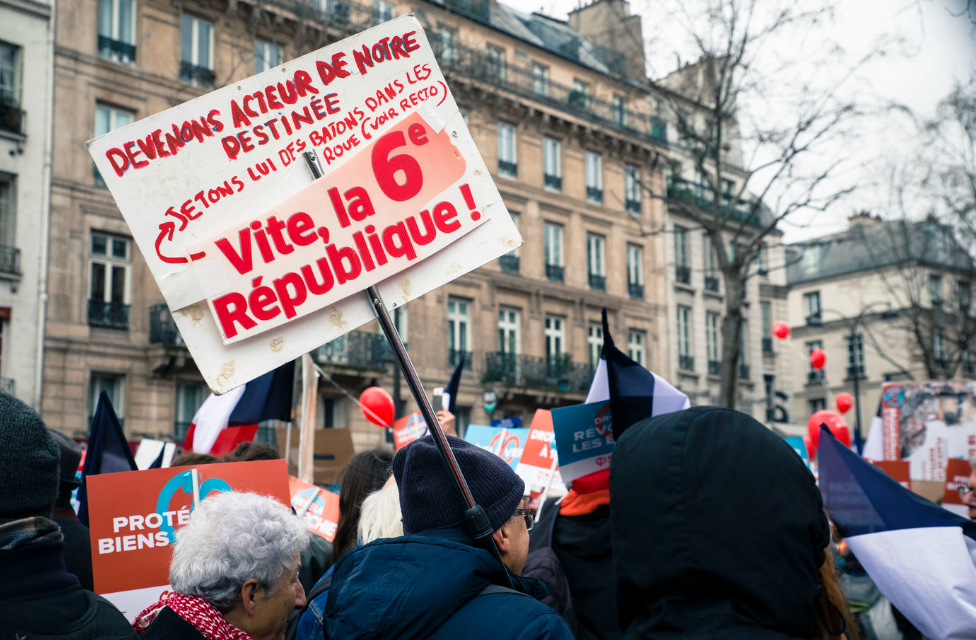
In conclusion, the dissolution of the National Assembly was ultimately a defining turning point for the French government, exposing its fragility, and the accelerated polarization of the parliament. Indeed, what was intended to be an instrument of renewal revealed a deeper fragmentation rooted in structural weaknesses. Whether this proves to be a short-lived turbulence or the beginning of a fundamental shift in French democracy now depends on the future responses of parties, institutions, and citizens to this uncertainty. The crisis may push France to adopt new policies, institutional mechanisms, or even a new order capable of addressing the reality that the country is facing.
Bibliography
Audureau, W. (2024, June 9). Tout comprendre à la dissolution de l’Assemblée nationale : conditions, précédents, conséquences… Le Monde.
https://www.lemonde.fr/les-decodeurs/article/2024/06/09/qu-est-ce-que-la-dissolution-de-l-assemblee-nati onale_6238345_4355770.html
David, R. (2024, July 16). Emmanuel Macron a accepté la démission de Gabriel Attal et de son gouvernement. Public Sénat.
https://www.publicsenat.fr/actualites/politique/emmanuel-macron-sapprete-a-accepter-la-demission-de-ga briel-attal-et-de-son-gouvernement
Edwards, C., Xu, X. & Kennedy, N. (2024, June 30). France sees huge turnout in snap parliamentary elections as far right seek gains. CNN.
https://edition.cnn.com/2024/06/29/europe/france-parliament-election-polls-open-intl
Gautheret, J. (2024, July 7). Could Macron set up a 'technocratic government' after the elections? A few lessons from the Italian experience. Le Monde.
https://www.lemonde.fr/en/politics/article/2024/07/07/could-macron-set-up-a-technical-government-after the-french-elections-a-few-lessons-from-the-italian-experience_6676897_5.html
Geoffroy, R., Sénécat, A. & Vaudano, M. (2024, July 8). Could Macron set up a 'technocratic government' after the elections? A few lessons from the Italian experience. Le Monde. https://www.lemonde.fr/en/les-decodeurs/article/2024/07/08/who-will-govern-france-four-questions-to-un derstand-what-happens-after-the-election_6677397_8.html
Taylor, P. (2025, October 7). French paralysis spells trouble for Europe. European Policy Center. https://www.epc.eu/publication/french-paralysis-spells-trouble-for-europe/


Comments