


The Eternal Country of Tomorrow

Death and Life of Brazilian Economic Growth
How is it possible that a country spanning over 8.5 million square kilometers, home to the world's largest freshwater reserve, blessed with abundant natural resources, a favorable climate, and remarkable geography, remains sidelined from global prominence? Brazil has never truly established itself as a global power, it is the eternal "country of the future", a future that never arrives. A nation that never quite fulfills its potential, forever postponing its own development. Some claim that Brazil's broad structural problems can be traced back to specific moments in its history. Others argue that the country's particular economic challenges were born from mundane causes. The truth, however, is that neither their origins nor their consequences will ever lead to undisputed diagnosis or straightforward solutions.

As a colony, Brazil experienced the brazilwood, sugar, and gold cycles. The coffee cycle began under the empire and continued well past the Proclamation of the Republic, lasting until the Great Depression in 1929. The nation then recovered and experienced decades of growth that now seem like a distant memory. Like every emerging economy, Brazil strives for economic growth and the consolidation of its institutions. But for a country that appears to have every ingredient for success, why has Brazil never taken off and why, more often than not, does it give the impression that it is sinking? Questions like these are compelling and have been asked for decades, yet no definitive answer has emerged. So instead, let us ask another question: why does Brazil, despite all the advantages naturally bestowed upon it, fail to catch up with developed economies?
In economics, convergence theory is the hypothesis that, given comparable institutions and savings rates, poorer economies tend to grow faster than richer ones and converge toward similar income levels due to diminishing returns to capital. Applying this model to Brazil, we observe that between 1930 and 1980 the country seemed to be converging. Brazil was among the fastest-growing economies in the world, with its growth peaking in the "Brazilian Miracle" of 1968–1973, when rates reached approximately 10% at the height of the military government. Brazil's GDP per capita rose from roughly 16.5% of the U.S. level in 1929 to 28% by 1980, representing a measurable convergence toward the world's richest economy. Over the same period, Brazil grew at rates comparable to those of successful convergence stories, averaging 6.8% annually between 1951 and 1980, similar to South Korea's 7.5% and not far behind Japan's 7.9%. After the 1980s, however, growth slowed substantially, and in the following decades Brazil remained largely stagnant.

How We Got Here
Following the 1973 oil crisis, Brazil faced a significant deterioration in its current account. Rather than accepting a recession, the military government chose to sustain its growth rates by financing large current account deficits and implementing the Second National Development Plan (II PND) through extensive external borrowing. Brazil continued to grow, but following the second oil shock in 1979 and the dramatic rise in international interest rates at the end of the decade, the strategy that had prolonged the country's rapid expansion at the cost of a dangerous dependence on foreign debt became unsustainable.
The Debt Crisis kickstarted what became known in Brazil as the Lost Decade. Beyond the debt burden, the decline in GDP growth, and the balance of payments crisis, another challenge emerged: inflation. To combat it, Brazil could have pursued an orthodox stabilization program, relying on conventional fiscal and monetary instruments. Instead, successive governments opted for heterodox plans, freezing wages, prices, and contracts in an attempt to halt inflation. The results were disappointing, to say the least. To make matters worse, the widespread indexation of the economy only aggravated the problem. Rather than restoring the population's purchasing power, indexation transformed yesterday's inflation into tomorrow's, allowing inflationary momentum to persist even in the absence of new economic shocks.
Such violent inflation severely shortened planning horizons. Long-term investment became increasingly difficult and projects with distant returns were discouraged. Throughout the 1980s and early 1990s, a series of stabilization plans (Cruzado, Bresser, Verão, Collor) attempted to break this inertial inflation. Yet they all failed.

Only with the Real Plan in 1994 did Brazil finally succeed in restoring economic stability. The plan combined the introduction of a new currency, fiscal adjustment, and a credible monetary framework, bringing an end to years of hyperinflation. Along with the new currency, Brazil adopted a decisive macroeconomic model in 1999 known as the macroeconomic tripod. The tripod's philosophy was built on three pillars: inflation targeting, a floating exchange rate, and fiscal responsibility. The stabilization achieved under this system in the late 1990s provided the predictability that had been absent throughout the Lost Decade. With predictability, families could plan their consumption, investment was stimulated, risk premiums decreased, and markets could breathe.
In the 2000s, Brazil began to grow once again. A favorable international environment, characterized by low interest rates and strong global demand for commodities, combined with the continuation of the Real Plan's principles and its macroeconomic framework, supported a new period of expansion. Even during the 2008 global financial crisis, Brazil's GDP experienced only a mild contraction of 0.1% in 2009. The economy rebounded strongly the following year, growing by 7.5%, as if the global financial crisis had been merely a ripple in a pond.
So why, even with this 2000s optimism, did Brazil fail to return to the sustained growth rates it had enjoyed before the debt crisis? The events of the 1980s may explain the interruption of Brazil's convergence, but they do not explain why, after the restructuring of the Brazilian economy in the 1990s and the promising beginning of the twenty-first century, the country once again slipped into stagnation.
In 2015, Brazil's GDP contracted by 3.5%, followed by another decline of 3.3% in 2016. The 2010s proved to be difficult years for the country. The pace of Brazil's structural reforms was insufficient to address the challenges facing the economy. What had seemed in the 2000s to be a promising beginning and a unique window of opportunity to put Brazil back on track gradually faded away. A path toward social development and sustained economic expansion had been laid out, yet it was replaced by misguided interventionism and the gradual abandonment of the stabilization mechanisms embodied in the macroeconomic tripod.
Throughout its history, spontaneity seems to have become part of the nation's economic ethos. For far too long, Brazil has been the country of improvisation, of "gambiarra". Without a clear strategy, there is no prospect of sustained economic progress. But a strategy targeting what?
All Roads Lead To Productivity
In order to resume its path towards economic growth, Brazil must confront its chronic problem: low productivity. As Nobel Prize-winning economist Paul Krugman famously wrote, "Productivity isn't everything, but in the long run, it's almost everything."
It would be convenient to take a list of Brazil's problems and build an argument around just one of them. There are plenty of candidates to choose from: corruption, poor education, crime, inequality, bureaucracy, political and judicial instability, among many others. Any of these arguments could be convincing because each of these factors carries its own share of responsibility for Brazil's lack of economic growth. That is precisely why this debate never ends. Despite their differences, they all share one thing in common: productivity.
Productivity is a key channel through which deeper institutional and regulatory factors translate (or fail to translate) into economic growth. Take human capital, one of the fundamental determinants of productivity, as an example. Why is Brazil's human capital relatively weak? We return to our list: poor education. A poorly educated workforce cannot produce as much value with the same resources as a better-educated one. But the effects of human capital extend far beyond workers' direct productivity. Low schooling levels among the workforce and weak management quality constrain productivity-enhancing reforms in Brazil and undermine the economy's capacity to absorb and benefit from technologies and production methods developed elsewhere. Thus, the country's human-capital deficit affects productivity both directly, through the workforce itself, and indirectly, by limiting the gains from technological diffusion and economic reforms. The same reasoning can be applied to many of these structural problems. They may differ in nature, but they all influence the same economic channel.
In this line of thought, a distinction should be made between two types of economic growth: growth by accumulating more inputs and growth by using existing inputs more efficiently. The two should not be treated as entirely independent sources of growth. Both played important roles throughout Brazil's development, but their relative contributions changed over time. Growth through factor accumulation is economic growth generated by increasing the quantity of factors of production available to the economy (adding more inputs), while growth through TFP (Total Factor Productivity) broadly reflects the growth generated by increasing the efficiency with which an economy combines and uses its existing factors of production. It is the portion of growth that isn't explained by adding more inputs. As the Brazilian demographic pyramid inverts and returns to capital diminish, Brazil's sustainable economic growth will crucially depend on the latter.
Gomes, Pessôa and Veloso (2003) showed that Brazil’s period of rapid convergence was not driven by factor accumulation alone. Between 1950-1967, the economy followed a balanced path as productivity advanced in line with the technological frontier and the capital-output ratio remained stable. From 1967 to 1976, TFP boomed, growing faster than the technological frontier, indicating a period of rapid productivity catch-up.
From 1976 to 1992, however, the pattern changed dramatically, with the country-specific component of TFP (that is, TFP net of technological frontier growth) falling by 38% over the period. In the meantime, Brazil experienced a substantial capital deepening, with the capital-output ratio rising from approximately 2 to 2.9. The country was therefore accumulating more capital while its productivity performance was deteriorating. From around 1980 onward, the marginal product of capital (the extra output an economy gets by adding one more unit of physical capital, while keeping all other inputs like labor constant) in Brazil was approximately equal to that of the United States despite Brazil having a far lower capital-labor ratio. If Brazil's relative scarcity of capital were by itself sufficient to generate rapid catch-up, we would expect the marginal product of capital to be considerably higher in Brazil. Instead, the evidence suggests that increasing investment alone is unlikely to generate another sustained growth period without simultaneous improvements in productivity. Between 1992 and 2000, Brazil returned to something resembling a balanced growth path: TFP once again grew in line with the technological frontier, while the capital-output ratio stabilized at around 2.7.
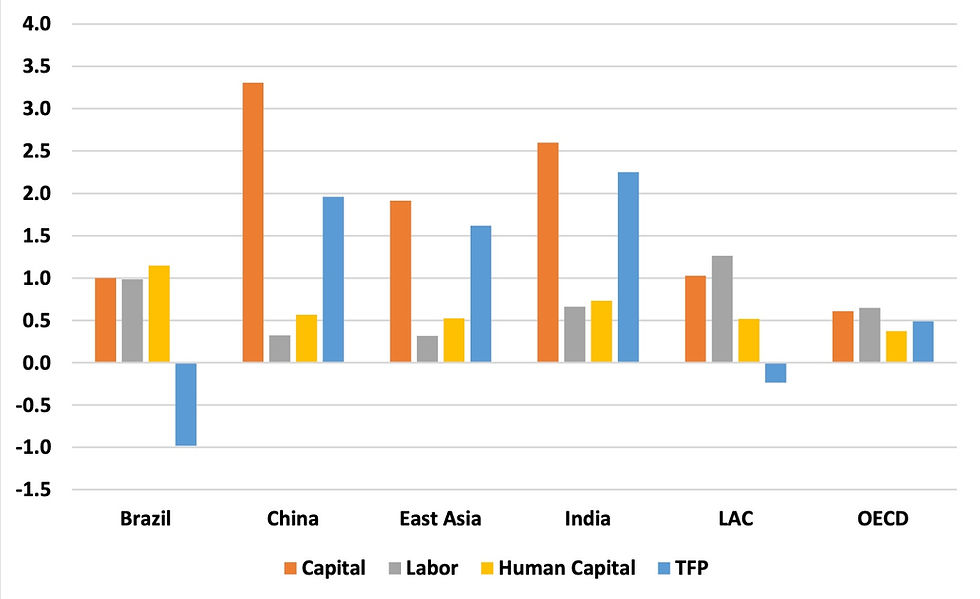
Veloso’s Productivity and Growth in Brazil (2021) offers a decomposition of Brazil's recent growth performance. Between 1997 and 2005, factor accumulation contributed 3.5 percentage points annually to Brazilian GDP growth, while TFP actually fell by 1.1% per year. Between 2006 and 2011, annual growth rose to 4.3% even though accumulation's contribution barely changed. The increase came from a temporary rebound in TFP. Then, between 2012 and 2019, both sources collapsed together: accumulation slowed to 2.5%, TFP fell by 2.2% per year, and overall growth dropped to a humble 0.3%. Internationally, while the Brazilian TFP fell at an average rate of 1% per year between 1997 and 2019, it rose by roughly 2% in China and 2.3% in India over the same period. Brazil underperformed not only fast-growing Asian economies, but its own regional peers; as the Latin American region, no stranger to its own problems, saw a far smaller decline in TFP of 0.2% per year.
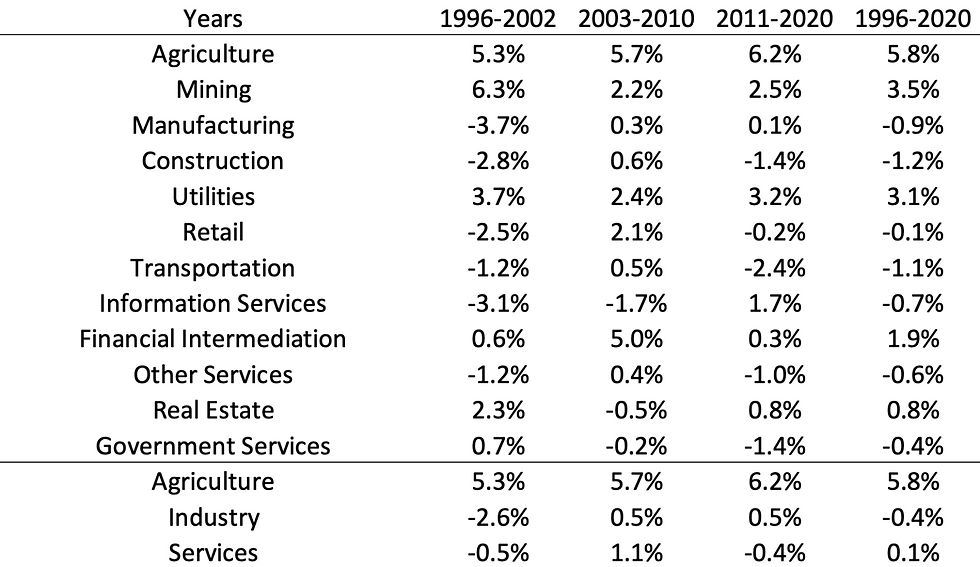
Comparing Brazil to the United States, Veloso shows that if Brazil had the same sectoral labor allocation as the U.S., aggregate productivity would increase by 68%. But if Brazilian sectors, structured as they are, matched the productivity of their American counterparts, the gain would exceed 430%. A similar exercise is repeated with a sample of developed countries and it suggests that Brazil could increase aggregate productivity by 50% if it had the same sectoral labor allocation and by 192% if it had the same sectoral productivity levels. Therefore, Brazil's core problem isn't how its economy is structured, but the low efficiency within its own sectors. In addition, firm-level data show that Brazil has a wider dispersion of labor productivity, and a larger share of low-productivity firms, than comparable emerging economies. This suggests that labor and capital are not being efficiently allocated across firms.
One Hand Gives, the Other Takes
In a healthy competitive economy, resources flow toward the most efficient businesses. In Brazil, however, several distortions prevent this process. Subsidized lending through BNDES (Brazilian Development Bank), for example, has repeatedly been found to have little or no effect on the productivity of the large firms that receive most of it. Even when positive results are identified, they are not strong enough to be considered cost-effective. Meanwhile, private lending spreads in Brazil have averaged around 40%, compared with roughly 10% in Uruguay, 3% in the United States, and under 1% in Japan. One study by Joaquim et al. (2019) found that reducing Brazilian spreads to world levels would increase output by approximately 5%. Moreover, Cavalcanti et al. (2021) show that, in their calibrated model, financial frictions as a whole reduce Brazil's output per capita by 31% and its TFP by 25% relative to a frictionless credit benchmark.
At the center of Brazil's low productivity problem is an environment that favors incumbents and blocks new entry. Even as Brazil implemented important reforms, it continued to discourage competition and induce resource misallocation through several distortions over the last two decades. The development model based on state intervention that characterized much of Brazil's twentieth century remains deeply rooted in its current model. For this reason, competitiveness becomes a central ingredient for productivity growth in Brazil. Evidence of this comes from Brazil's own experience. In the late 1980s and continuing through the first half of the 1990s, Brazil substantially reduced its protection from foreign competition, with average import tariffs falling from approximately 31% to 13%. The literature reviewed by Veloso found significant productivity gains from trade openness at the firm level, operating both through a competitive channel that rewarded efficient firms and through the diffusion of foreign knowledge and technology. These gains, however, did not fully translate into aggregate productivity growth during the 1990s. Despite the successful increase in productivity at the firm level, frictions in the reallocation of labor limited the aggregate benefits of liberalization.
Hence, any sustained increase in productivity will require both the restoration of more competitive market conditions and a more efficient allocation of productive resources. Rather than inefficient firms exiting the market, productive firms expanding, and innovation being stimulated, in Brazil's current environment the opposite often occurs, and TFP suffers as a result. Taken together, these findings make Brazil's case look less like bad luck and more like the outcome of a system that not only tolerates but protects inefficiency. Too often, Brazilian reforms are sabotaged by the country’s own configuration.
Where We Are and Where We Can Go
Brazil's case can be understood as an illustration of conditional convergence. Developing economies do not automatically converge toward developed ones, as different economies tend to converge toward very different steady states. Brazil's rapid catch-up throughout much of the twentieth century was therefore not a guarantee that it would continue growing at high rates until it reached the level of developed economies. In this sense, Brazil is stuck in what is often called — though not uncontroversially — a middle-income trap.
The country exhausted much of the "low-hanging fruit" that allows developing economies to grow rapidly through structural transformation, factor accumulation, and the adoption of existing technologies. Beyond this point, adding more inputs without technological or organizational improvement pushes an economy toward a new steady state, not to a constant higher growth rate. Diminishing returns make further convergence increasingly dependent on within-sector productivity gains and, therefore, on the conditions that allow those productivity gains to happen.
The right national strategy, then, is not to just "increase productivity" as though that were a policy lever to be pulled, as productivity cannot simply be legislated into existence. Instead, the task is to create the conditions under which productivity can emerge on its own: improved human capital, better infrastructure, greater competition, more efficient allocation of resources, and the right rules of the game. As we have seen, some reforms may succeed at the microeconomic level without fully translating into aggregate gains. Rather than the product of any single policy, higher productivity is the cumulative result of coherent long-term reforms across different areas of the economy, coupled with an environment that allows their effects to reinforce one another. Gambiarra may be ingenious when solving an immediate problem, but it is no substitute for a successful development strategy. Productivity-enhancing reforms take time to show results; because of that, institutional persistence and coordination become crucial. A difficult barrier must therefore be broken in Brazil. Improvisation may serve to patch things up in the short run, but sustained development takes decades.
None of these reforms, however, can operate in a macroeconomic vacuum. As Brazil's experience with the Real Plan and the macroeconomic tripod demonstrated, fiscal stability is a precondition for a broader growth strategy to work, rather than just another item on that list of problems to be solved. Brazil's highly rigid expenditure structure makes this particularly difficult to address, meaning that any credible fiscal adjustment will necessarily require greater control over public spending. The lesson from Brazil's recent economic history is therefore not that stability alone creates growth, but that growth becomes extraordinarily difficult without it. Productive investment is a decision based on confidence about the future. Thus, firms operating in the market must be able to trust the rules of the game, the country’s macroeconomic policy, and that the nation’s direction will not change arbitrarily. Only then can they confidently compete, innovate, and take risks. The government, on the other hand, should provide that predictability, establish horizontal rules, and set a coherent long-term direction. This is the kind of continuous dialogue between the public and private sectors that is indispensable.
Nothing guarantees that developing countries will inevitably catch up with rich ones, so why should Brazil be destined to succeed? Having the right ingredients is not the same as having the right recipe. National optimism is not an economic variable, and there is a certain arrogance in repeatedly calling Brazil the "country of the future" when doing so overlooks the country's own responsibility for achieving it. Such a promise will never be fulfilled by simply waiting and wishing for it. The clock is ticking. A prosperous future is not an entitlement.
Bibliography
Canuto, O., Dinh, H. T., & El Aynaoui, K. (2024, March). The middle-income trap and resource-based growth: The case of Brazil. Policy Center for the New South. https://www.policycenter.ma/sites/default/files/2024-03/RP_05-24%20%28Otaviano%20Canuto%20-%20Hinh%20T%20Dinh%20and%20Karim%20El%20Aynaoui%20%29.pdf
Cavalcanti, T. V., Kaboski, J. P., Martins, B. S., & Santos, C. (2021, April). Dispersion in financing costs and development. National Bureau of Economic Research.
Gomes, V., Pessôa, S. A., & Veloso, F. A. (2003). Evolução da produtividade total dos fatores na economia brasileira: Uma análise comparativa [Evolution of total factor productivity in the Brazilian economy: A comparative analysis]. Pesquisa e Planejamento Econômico, 33(3), 389–434. https://repositorio.ipea.gov.br/server/api/core/bitstreams/29a0b21e-ee2a-46b3-867c-5265c2b798be/content
Joaquim, G., Van Doornik, B., & Ornelas, J. R. (2019, October). Bank competition, cost of credit and economic activity: Evidence from Brazil. Banco Central do Brasil.
Mendes, M., Veloso, F., & Botelho, V. (Eds.). (2026). Caminhos do desenvolvimento: Estabilizar, crescer, incluir — Resumo [Paths to development: Stabilize, grow, include — Summary]. Centro de Debate de Políticas Públicas. https://site-be.cdpp.org.br/uploads/cdpp_caminhos_desenvolvimento_resumo_e39f415b25.pdf
Pinheiro, A. C., Gill, I. S., Servén, L., & Thomas, M. R. (2004, May). Brazilian economic growth, 1900–2000: Lessons and policy implications. Inter-American Development Bank. https://publications.iadb.org/en/publications/english/viewer/Brazilian-Economic-Growth-1900-2000-Lessons-and-Policy-Implications.pdf
Schwarcz, L. M., & Starling, H. M. M. (2015). Brasil: Uma biografia [Brazil: A biography]. Companhia das Letras.
Sottomaior, L. (2015). Economia brasileira: A história contada por quem a fez [Brazilian economy: History told by those who made it] [Documentary series]. Cultura Maior.
Veloso, F. (2021). Productivity and growth in Brazil. FGV IBRE.https://ibre.fgv.br/sites/ibre.fgv.br/files/arquivos/u65/veloso_productivity_and_growth_in_brazil.pdf



Comments