


The End of the Ice Age

How access to the Arctic region will reshape the world order
In the late third millennium BCE, the Akkadian Empire stood as the most formidable political achievement yet produced by human civilisation. Often described as history’s first empire, it emerged around 2340 BCE from a network of Sumerian city-states through the military conquests of Sargon of Akkad. Perhaps for the first time, a single polity exercised sustained territorial control across a vast region, stretching at its height from the Persian Gulf to eastern Syria. Yet, around 2250 BCE, this unprecedented imperial structure collapsed suddenly and violently. For decades, historians attributed this rupture primarily to the invasion of the Gutians, a loosely organised people originating in the Zagros Mountains. However, as archaeological research progressed, a more fundamental explanation began to take shape.
Analyses of marine sediments and terrestrial records indicate that the region experienced a sudden and severe megadrought, now widely regarded as a major contributing factor to the Akkadian collapse. Prolonged aridity likely triggered agricultural failure, population displacement, and systemic stress across imperial institutions. While scholars continue to debate the relative weight of climatic versus social and administrative failures, there is broad agreement that environmental change acted as a powerful destabilising force. The Akkadian case is not unique. Multi-decadal droughts during the Bronze Age Collapse, monsoon weakening during the decline of the Indus Valley civilisation, and volcanic-induced cooling in late antiquity have all been linked to periods of widespread social disruption. Across historical contexts, climatic shocks have repeatedly served as catalysts that magnify underlying political and economic vulnerabilities.
Although the Akkadian collapse may represent one of the earliest recorded instances in which climate significantly altered the trajectory of a civilisation, it was far from the last. Today, human societies once again face a climatic transformation with the potential to reshape global stability. In the Arctic, anthropogenic climate change is driving a rapid decline in sea ice, which has been shrinking at an average rate of 12.2 per cent per decade. From a minimum extent of approximately 7.5 million square kilometres in 1980, Arctic sea ice has fallen to roughly 4.6 million square kilometres today. Projections suggest that the Arctic could experience its first ice-free summer day before 2030. For those concerned with long-term environmental stability, these developments are deeply troubling. However, for states with the political and material capacity to operate in the region, diminishing ice cover presents unprecedented strategic opportunities. Securing Arctic interests in the present may yield economic and geopolitical advantages that extend for decades, with significant implications for the global balance of power.

Cold Open: Introduction to the Arctic
The Arctic is the Earth’s northernmost region, centred on the North Pole and commonly defined as the area north of the Arctic Circle at 66.5° N latitude. It encompasses the northern territories of Russia, Canada, Greenland (Denmark), Alaska (United States), Norway, Sweden, and Finland, as well as several island groups including Svalbard, Severnaya Zemlya, and Franz Josef Land. The region is characterised primarily by tundra and polar desert landscapes and is home to approximately four million people, many of whom are indigenous. At its centre lies the Arctic Ocean, the smallest and shallowest of the world’s five oceans. Although it remains covered by extensive ice, an increasing proportion of this layer is seasonal rather than perennial.
Despite the moderating influence of surrounding seas, Arctic temperatures range from approximately –40°C in winter to 10°C in summer. This variability is driven largely by extreme solar forcing, with continuous daylight in summer and prolonged darkness in winter producing substantial seasonal fluctuations in sea ice extent. In recent decades, Arctic sea ice extent has varied dramatically between the summer and winter months, reaching a maximum of 14.33 million square kilometres and a minimum of 4.6 million square kilometres in 2025, a reduction of roughly 68 per cent. These conditions render most commercial activity highly seasonal. While the Arctic Ocean remains nearly impassable between November and May, limited navigable corridors emerge between June and October for actors equipped to operate in extreme conditions. Even then, ice cover varies significantly from year to year, reinforcing the region’s volatility.
The Rome Statute came into effect in the early 2000s and almost immediately afterwards the bipartisan American Service-Members’ Protection Act (ASPA) was enacted in the US. This act relied on legal and political insulation from the court rather than direct coercion of the court’s officials. Nicknamed the “Hague Invasion Act,” it authorized the President to use “all means necessary and appropriate” to secure the release of coveted American or allied personnel held “by, on behalf of, or at the request of” the ICC. The underlined message was that only America would prosecute its people, and that anybody trying to prosecute Americans would be violating its sovereignty.

The Myth of Arctic Exceptionalism
To those uninitiated, it may come as a surprise that any state would have reason to project power in the Arctic. What, after all, is to be gained in a region so barren, inhospitable, unpredictable, and, for now, accessible for only a few months each year? In the aftermath of the USSR’s collapse in 1991, even the residual military rationale for securing the Arctic appeared to evaporate. The region was instead recast as a space of cooperation, giving rise to a series of confidence-building initiatives unprecedented in other strategic theatres. The Arctic Environmental Protection Strategy (AEPS) was launched in 1991 amid growing concern over Arctic pollution and long-range contaminants, and in 1996, the Arctic Council was established as a high-level forum for cooperation, sustainable development, and scientific research. Together, these institutions formed the backbone of what would later be termed Arctic Exceptionalism: a political narrative portraying the Arctic as a ‘peaceable regime’, insulated from the conflicts and power politics that dominate international relations elsewhere. This framing was reflected in contemporary public opinion. In a 2011 Canadian survey, ‘the environment’ was ranked as the most important issue facing the Arctic, while ‘national security’ was ranked the least salient dimension of Arctic security. Such views appeared to confirm the durability of Arctic Exceptionalism as both a political and normative project.
In retrospect, however, Arctic Exceptionalism functioned less as a durable condition than as a form of conceptual inertia. It allowed regional actors to defer difficult questions concerning militarisation, resource extraction, and overlapping territorial claims by appealing to cooperative and scientific rhetoric. Yet the assumption that the Arctic, or any region, could be placed squarely outside of the realm of geopolitics was farcical from the outset. Russia’s symbolic planting of a flag on the seabed at the North Pole in 2007 marked an early rupture in this narrative, but it was far from an isolated incident. Since then, maritime boundaries have been contested and extended, fishing and other commercial activities have expanded markedly, and the soft power of non-Arctic states, most notably in the form of Chinese investment, has steadily penetrated the region. However, if 2007 represented a staggering blow to Arctic Exceptionalism, the period between 2022 and 2025 delivered its summary execution. Russia’s invasion of Ukraine led to the suspension of Arctic Council cooperation involving Moscow, severely impairing its activities, while the United States has increasingly threatened the sovereignty and political autonomy of its Arctic neighbours. At the time of writing, the so-called “Arctic peace dividend” has come to an end.
The re-emergence of great power competition in the Arctic cannot be explained through historical analysis alone. Beneath the rhetoric of cooperation, the material foundations of Arctic engagement were undergoing a gradual transformation. As the ice pack continued to recede, the region shifted from a peripheral environmental concern to an arena of growing commercial and strategic significance. This value is directly tied to accessibility, and as climate change continues to reshape the Arctic’s physical environment, it is only set to increase further. At its core, the strategic importance of the Arctic derives from three interrelated objectives: control over emerging shipping lanes, access to abundant natural resources, and military security.
Breaking the ice: Shipping lanes
Of these three objectives, the expansion of trade through Arctic shipping lanes represents the most transformative consequence of increased accessibility. Melting sea ice is opening new maritime routes linking Asia, Europe, and North America, reducing average shipping times between Europe and Asia from thirty-seven days to twenty-two, and between the United States and Asia from forty-three days to thirty-two. Even accounting for the need for polar-class vessels, one comparative study found that an Arctic route can be up to 42 per cent more cost-efficient than transit via the Suez Canal, yielding potential savings of approximately $4.7 million per full round voyage. With such substantial efficiencies at stake, it is unsurprising that maritime activity in the region has expanded rapidly. While the number of unique vessels operating in the Arctic increased by a relatively modest 37% between 2013 and 2023, the total nautical miles travelled by these vessels rose by 111% over the same period. Although fishing vessels continue to constitute the largest absolute share of Arctic traffic (34%), the most pronounced relative growth has occurred among gas tankers (+3100%) and crude oil tankers (+158%), a trend that is indicative of the region’s evolving commercial profile. As Arctic shipping has expanded, attention has increasingly converged on a set of three maritime routes whose governance, accessibility, and legal status have become central to regional competition.

The Northern Sea Route (NSR) is widely regarded as the most viable of the three Arctic shipping corridors and is by far the most active. Running along Russia’s Arctic coastline, it connects the Barents Sea in the west to the Bering Strait in the east. From the Kara Sea, the route traces Russia’s northern shoreline across the Laptev, East Siberian, and Chukchi Seas before entering the Pacific Ocean via the Bering Strait. Much of the NSR lies within Russia’s Exclusive Economic Zone (EEZ), and several segments fall within its internal waters. As a result, vessels transiting the route are often required to obtain authorisation from Russian authorities, a precondition that has limited its use by Western shipping firms. Despite these constraints, trade volumes along the NSR increased by 755 per cent between 2014 and 2022, and Moscow has announced ambitions to expand traffic tenfold by 2035. While higher construction costs for ice-class vessels, navigational uncertainty, and elevated operational risks all factor into the economic calculus of using the NSR, cost analyses suggest that, beyond transit time, the most significant contributors to overall voyage costs are fees associated with navigation along the route imposed by the Russian Federation and the use of Russian bunkering services. Should the Russian Federation succeed in establishing a reliable and predictable passage along the NSR, it would acquire a potent economic instrument with far-reaching political implications.
As an alternative to the NSR, the Northwest Passage (NWP) traverses the Canadian Arctic Archipelago, linking the Atlantic and Pacific Oceans via a series of channels that ultimately connect to the Bering Strait. Unlike the NSR, the NWP does not constitute a single, continuous corridor but rather a set of possible routes weaving between islands such as Baffin, Victoria, and Banks Islands through narrow and often shallow straits. These waterways are highly complex and ice-prone, with pronounced interannual variability in navigability, rendering the passage a less reliable transit option than the NSR. As a result, traffic levels remain comparatively low, with fewer than 500 vessels having completed a full transit of the NWP to date. Nonetheless, the long-term strategic outlook of the passage is shifting. Projections suggest that most NWP routes could experience fully ice-free conditions during the summer months before 2050, a development that may enhance its commercial appeal, particularly in light of the political constraints associated with the NSR. Even so, the NWP is itself entangled in unresolved legal disputes. Canada maintains that the passage lies entirely within its historic internal waters, while other maritime powers, most notably the United States, argue that it constitutes an international strait under Article 37 of the United Nations Convention on the Law of the Sea (UNCLOS). Although this disagreement has thus far been managed pragmatically, rising Arctic shipping activity is likely to intensify legal and diplomatic friction in the years ahead.
Finally, unlike both the NSR and the NWP, the Transpolar Route (TSR) does not trace a continental coastline or pass through an archipelago. Instead, it cuts directly across the central Arctic Ocean, traversing the deep Arctic basin. This makes it the shortest and deepest of the three routes and, critically, the one least encumbered by coastal jurisdiction. Because the TSR lies largely beyond the territorial waters and exclusive economic zones of Arctic coastal states, it is of particular interest to actors seeking a trans-Arctic corridor that avoids national regulatory control. In 2012, the Chinese icebreaker Xue Long became one of the first major vessels to complete a transit along the route, and a small number of additional crossings have occurred since. Despite these advantages, the TSR remains the least viable of the three routes in the near to medium term. Even under high global emissions scenarios, projections suggest that the route will not be accessible to open-water vessels on a regular basis before 2090, with more moderate climate pathways pushing this timeline further into the future. Moreover, the TSR lacks supporting infrastructure, including ports, search-and-rescue facilities, and nearby icebreaker assistance. As a result, its operational viability is likely to remain highly seasonal and contingent on the availability of polar-class vessels, with winter navigation continuing to rely on the NSR or NWP for the foreseeable future.
Underneath the Ice: Natural Resources
While Arctic shipping routes are often discussed in terms of transit efficiency and commercial connectivity, their strategic significance is inextricably linked to their role in facilitating access to the region’s vast natural resource base. Climate-driven environmental change is not only reshaping patterns of mobility, but also transforming the physical and economic conditions under which extraction can occur. Thawing permafrost, longer ice-free seasons, and reduced operational hazards have collectively lowered some of the historical barriers to resource development in the Arctic. Although extraction in the region remains capital-intensive and technologically demanding, these changes have altered cost-benefit calculations for both state and private actors. As a result, the Arctic is increasingly viewed as not merely a transit space, but also a reservoir of strategic materials whose exploitation carries significant economic, political, and security implications.
The Arctic’s most substantial natural resource endowment lies in oil and natural gas, with a pronounced emphasis on the latter. According to the U.S. Geological Survey’s Circum-Arctic Resource Appraisal, the region contains approximately 22 per cent of the world’s undiscovered oil and gas resources. This estimate corresponds to roughly 90 billion barrels of technically recoverable oil, 1.699 trillion cubic feet of natural gas, and 44 billion barrels of natural gas liquids. Taken together, natural gas and natural gas liquids account for approximately 78 per cent of the Arctic’s total fossil fuel resource base. The geographic distribution of these resources is highly uneven. Around 60 per cent (by barrels of oil equivalent) are located on Russian Arctic continental shelves, particularly in basins such as West Siberia and the East Barents Sea, while smaller shares are attributed to the United States (approximately 18 per cent) and to Denmark, via Greenland (approximately 8 per cent). A further 12.4 per cent is estimated to lie within multi-jurisdictional or internationally shared shelf areas. Despite the predominance of conventional hydrocarbons, typically trapped in porous rock formations and therefore technically less complex to extract, development in the Arctic remains exceptionally challenging. Extreme environmental conditions, limited infrastructure, and long distances from markets continue to impose significant logistical and financial constraints. Moreover, although temperatures are rising, transportation, processing, and refining infrastructure in the Arctic is sparse compared to other major hydrocarbon basins. These challenges are compounded by the fact that commercial development has historically focused on onshore reserves, even though approximately 84 per cent of the Arctic’s fossil fuel resources are believed to be located offshore.
The second major resource category driving strategic interest in the Arctic is critical minerals. The region already accounts for more than 10 per cent of global production of several key materials, including platinum, palladium, and nickel. This role is expected to expand rapidly. Whereas Greenland hosted only a single operational mine in 2012, it has since issued over one hundred exploration and extraction permits, while the Russian Federation has developed a comprehensive, state-directed framework for Arctic mineral exploitation. Arctic geology further amplifies this potential, as many deposits are polymetallic, allowing a single mining operation to yield multiple commercially valuable by-products. Large nickel or copper deposits, for example, may also contain trace quantities of far more strategically significant materials. Among these, Rare Earth Elements (REEs) and Platinum Group Metals (PGMs) are of particular importance. REEs are essential inputs for renewable energy technologies and advanced manufacturing, while PGMs play a critical role in industrial processes and electronics production. Given the extreme geographic concentration of both REEs and PGMs, coupled with projected growth in global demand, Arctic deposits are likely to become focal points of strategic competition. Nonetheless, mineral development in the region remains constrained. Projects in Greenland continue to face substantial regulatory and permitting hurdles, while offshore mining has encountered strong opposition from environmental organisations and local communities. Moreover, securing strategic leverage from Arctic mineral resources depends not only on extraction, but also on downstream processing and refining capacity—a segment of the value chain currently dominated by China. In the near to medium term, therefore, the Arctic is unlikely to emerge as a dominant global supplier of critical minerals, even as its long-term strategic relevance continues to grow.

A final, but often underemphasised, category of Arctic resources consists of renewable natural resources, most notably fisheries and forests. Arctic and sub-Arctic waters currently account for approximately 10 per cent of the global wild fish catch, driven primarily by commercially valuable species such as cod, pollock, and herring. The strategic importance of these fisheries is expected to grow as climate change accelerates a process known as borealisation, whereby sub-Arctic fish stocks shift northward into cooler Arctic waters in response to rising ocean temperatures. While this may expand commercial opportunities in high-latitude regions, it also introduces new challenges related to stock management, jurisdiction, and the livelihoods of coastal and Indigenous communities. Similarly, immediately south of the Arctic Circle lies the circumpolar boreal forest belt, which contains an estimated 25–33 per cent of the world’s forested area. Although these forests are largely outside the Arctic proper, their proximity ties them closely to Arctic economic dynamics. As infrastructure, transport links, and commercial activity expand northward, boreal timber resources are likely to attract increased economic and strategic attention. Taken together, the growing accessibility of both marine and terrestrial renewable resources underscores a broader trend: as Arctic conditions become more conducive to sustained economic activity, longstanding governance gaps and dormant sovereignty disputes are likely to resurface.
A Brief Aside - What is Arctic Power?
Before turning to military security, the final presiding objective in securing the Arctic, it would be useful to briefly advance our understanding of ‘Arctic Power’. In this context, Arctic power refers to the strategic, operational, and tactical capabilities that states employ to secure their interests in the Arctic environment. The region’s snow and ice cover, persistent sub-zero temperatures, and highly variable, inhospitable terrain impose demands that differ markedly from those associated with conventional military operations. Although Arctic policy documents issued by regional states vary in both emphasis and tone, particularly in their balance between deterrence and cooperation, four key dimensions come to the forefront with notable frequency: ice-capable vessels, Arctic forces, logistics infrastructure and communication infrastructure.
For the foreseeable future, sea ice will remain the central obstacle to Arctic navigation, particularly during the winter months. As a result, manoeuvrability in the Arctic is closely tied to the possession of polar-class vessels capable of operating in extreme ice conditions and, where necessary, breaking and clearing ice for follow-on traffic. Icebreakers, large, heavily reinforced vessels that are often nuclear-powered, therefore occupy a central role in Arctic power projection. Their construction is both technically complex and financially burdensome: Russia’s most recent Project 22220 nuclear icebreakers have each required multiyear construction timelines and investments exceeding one billion euros per vessel. While most Arctic states possess only a handful of such ships, the Russian Federation operates a fleet of more than forty icebreakers, giving it a decisive advantage. This dominance, however, may prove difficult to maintain. The war in Ukraine has slowed Russia’s icebreaker construction programme, while other Arctic states have begun to signal renewed investment in icebreaking capacity. Most notably, the United States, Canada, and Finland have entered into a formal cooperation framework aimed at jointly developing and constructing new icebreakers.

Additionally, military personnel must be trained and equipped for extreme cold-weather operations. Standard military equipment often does not function reliably in Arctic temperatures, and units not specifically trained for high-latitude operations require extensive preparation and specialised gear. Many Arctic states long maintained expertise in cold-weather training, but recent years have seen a marked increase in joint exercises focused on cold-weather and Arctic warfare.
Beyond capabilities and training, logistics and communications infrastructure are essential for sustained military operations above the Arctic Circle. Reliable supply routes, forward operating locations, and support facilities such as ports, piers, and maintenance depots are frequently cited as fundamental needs given the current paucity of infrastructure in the region. High latitudes also stress traditional communication systems, as satellite geometry and atmospheric conditions complicate the circulation of information. Coupled with expanded military presence and exercises, these requirements point toward increased defence-related capital investments in the Arctic in the coming years.
Projecting Arctic Power: Military Security
During the era of Arctic Exceptionalism, a period of actionable peace settled over the region. As Russia turned inward to rebuild state capacity after the collapse of the USSR, the United States directed military priorities elsewhere. Only some Nordic countries maintained a relatively modest military presence, and with the establishment of the Arctic Council in 1996 the centre of gravity of Arctic diplomacy took on a distinctly cooperative tone. In that prevailing calm, it became easier to downplay the structural factors that have long made the region strategically sensitive: Russia’s direct land borders with Norway and Finland, its narrow maritime approaches to the United States, and the growing physical and economic involvement of China have all contributed to a more contested Arctic security environment.
The need to secure the Arctic stems primarily from strategic geography: northern approaches compress distance, and the shortest routes for long-range aviation and missile trajectories between North America and Eurasia run across the High North. This makes the region central not only to force posture, but also to surveillance, early warning, and missile-defence architectures. The point is illustrated by the proximity of infrastructure on both sides of the Bering/Chukchi approaches: Russia has maintained a military facility on Wrangel Island, roughly 480 km from Alaska, while the United States operates strategically significant radar capability at Eareckson Air Station on Shemya Island. As Arctic accessibility increases, the operational relevance of these northern approaches, alongside the requirement to monitor them persistently, can be expected to grow rather than diminish.
Any assessment of Arctic military security must grapple with the dominance of one actor in particular: the Russian Federation. Russia possesses the longest Arctic coastline, extending over 24,000 km for more than half of the total Arctic littoral. This confers substantial geographic leverage in the region, particularly when considering the fragmented nature of the remaining territory. This advantage is reinforced by the legacy of extensive Soviet-era military infrastructure, much of which lay dormant after the Cold War but has since been reactivated, modernised, and remilitarised. As a testament to this legacy, of the 69 active military sites currently identified across the Arctic, 32 are administered by the Kremlin. As discussed previously, Russia also enjoys a decisive advantage in icebreaker capacity, granting it superior access and operational endurance, especially during winter months, and it significantly expanded its stock of Arctic-trained units during the 2010s. However, the ongoing war in Ukraine has diverted substantial manpower and equipment away from these Arctic formations. Finally, Russia’s control over the Northern Sea Route as a continuous, nationally administered transit corridor, combined with its network of bases on Arctic islands and along the northern coast, affords it a marked advantage in logistics and sustainment infrastructure, further consolidating its military position in the High North.
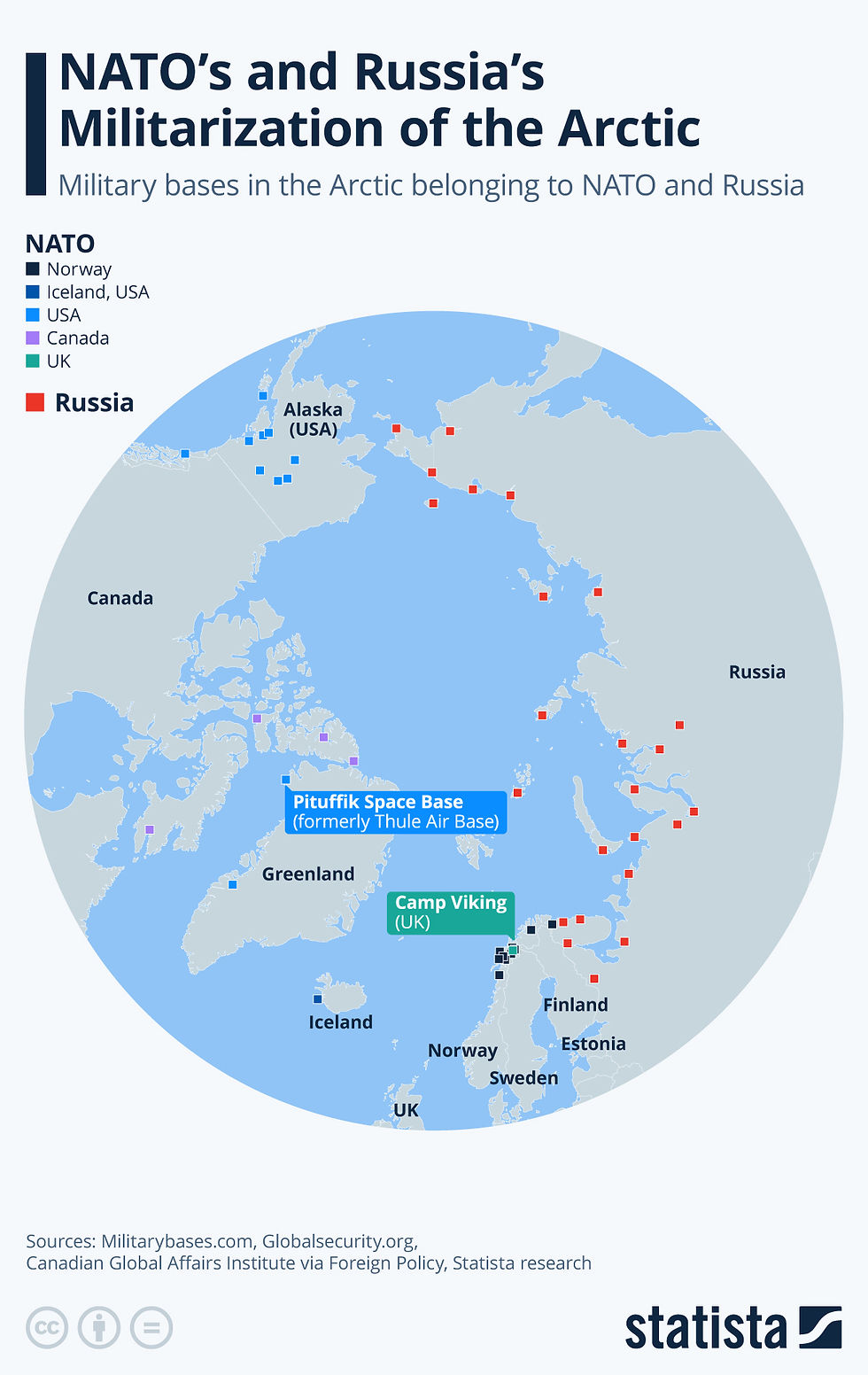
Given the scale of its Arctic territory and its adversarial relations with neighbouring states, it is perhaps a natural strategic response for Russia to seek greater economic and political involvement in the region from one of its most powerful partners: China. While Beijing maintains no formal military presence in the Arctic, it has made substantial investments in the region, designating itself, in 2018, a “near-Arctic state”, citing significant economic, political, and environmental interests. Western analysts have expressed concern over the potential dual-use nature of some Chinese activities, particularly civilian research and infrastructure projects that could support intelligence collection or military operations, as well as joint Russia-China training exercises in near-Arctic regions and the growing operational experience of Chinese polar-class vessels. These developments are of particular relevance when viewed through the lens of China’s Military-Civil Fusion policy, which explicitly aligns civilian infrastructure with military objectives and facilitates the transfer of technology and capabilities between the two domains.
Given Russia’s regional dominance, China’s growing presence, and the increasing strategic importance of the Arctic, one might consider this issue as a chance for enhanced unity among NATO states. However, the United States, under President Donald Trump, has adopted a markedly different approach. While American Arctic policy formally emphasises cooperation with NATO allies as essential to homeland defense, particularly in light of Finland’s and Sweden’s accession to NATO, the United States’ practical posture has often diverged from this stated objective. Repeated threats to take over Greenland, along with President Trump’s public suggestions of annexing Canada as a fifty-first state, have strained relations and undermined cooperative Arctic governance. Rather than reinforcing long-term collective efforts to contain Russian dominance and blunt Chinese influence, the USA’s approach has prioritised short-term pressure on allies. This dynamic is especially problematic given the absence of a dedicated NATO joint command for the Arctic, a gap highlighted by experts and only partially and informally addressed through JFC Norfolk, whose official focus is the Atlantic Ocean. Securing effective Arctic cooperation will therefore require a substantially more consistent and cooperative posture from NATO states active in the region.
The Arctic Toolbox: Avenues for Negotiation
Having examined the principal drivers behind the renewed strategic interest in the Arctic, a critical question remains: what avenues for negotiation and governance remain available? In an evolving and increasingly fragmented international order, adherence to rules-based frameworks and international norms appears decidedly less assured. Nonetheless, it remains necessary to keep in consideration these institutional arrangements, as they are likely to shape, constrain, or facilitate negotiations over Arctic governance and territorial issues in the years ahead.
The Arctic Council continues to function as the primary intergovernmental forum for cooperation among the Arctic states. It facilitates meetings among Senior Arctic Officials and ministers, issues declarations, and oversees a set of working groups tasked with implementing programmes and policy initiatives within its mandate. Yet the Council’s capacity to address the emerging challenges of the Arctic is increasingly questioned. From its inception, the Arctic Council has prioritised environmental protection and sustainable development, a focus reflected in the orientation of its six working groups, which address climate change, biodiversity, the marine environment, sustainable development, safety, and scientific cooperation. Of these, only the sustainable development working group engages with economic issues, and even then, only tangentially. At the same time, the suspension of Russian participation has undermined the Council’s status as a genuinely multilateral forum, while several of the most pressing challenges facing the Arctic, notably the military dimensions of regional competition, lie explicitly outside the Council’s scope. Absent a substantial expansion of its mandate and political authority, the Arctic Council is likely to be relegated to the periphery of Arctic politics, functioning more as an institutional artefact of Arctic Exceptionalism as geopolitical competition intensifies.
As mentioned earlier in the context of the Northwest Passage, the United Nations Convention on the Law of the Sea (UNCLOS) constitutes another key international mechanism through which states have sought to assert influence in the Arctic. UNCLOS governs rights over ocean space, seabed resources, and navigation, making it central to both trade and resource extraction in the region. It delineates territorial seas, extending up to 12 nautical miles from a state’s coastline and subject to national jurisdiction, and exclusive economic zones (EEZs), extending up to 200 nautical miles, within which coastal states enjoy exclusive rights to resource exploitation while other states retain freedom of navigation. Crucially, however, UNCLOS article 76 permits states to extend their seabed rights if they can demonstrate that it represents a prolongation of their continental shelf, complicating arctic resource ownership. Similarly, Article 38 establishes a right of transit passage through straits used for international navigation, even when such straits fall within a state’s territorial seas, a provision that bears directly on competing claims over the Northern Sea Route and the Northwest Passage. Crucially, all Arctic countries, save for the United States, have ratified the UNCLOS, making the USA’s position on the NWP somewhat paradoxical. While for years, the UNCLOS has prevented open conflict by channelling competition into scientific research, the interpretation of its articles is likely to sow discord between Arctic nations as the region’s trade routes and resources continue to become more accessible.
A more recent addition to the Arctic governance toolkit is the High Seas Treaty, which entered into force in January 2026. Although the agreement operates within the broader legal framework of the UNCLOS, its provisions are more expansive, most notably in enabling the establishment of Marine Protected Areas (MPAs) beyond national jurisdiction. While the designation of MPAs alone is unlikely to prevent deep-sea mining or other forms of resource exploitation fully, their introduction and enforcement in Arctic waters could significantly constrain the scope and permissibility of extractive economic activity. As such, the High Seas Treaty introduces a new variable into Arctic negotiations. It remains to be seen whether it will exacerbate competition by providing states with an additional instrument to contest access, or instead function as a novel mechanism through which coalitions of states can collectively protect shared resources.
Conclusion: The Opening of the Arctic
It appears that the opening of the Arctic may represent the latest instance in a historical pattern of climatic change fundamentally reshaping the trajectory of human societies. The emergence of trans-Arctic trade routes capable of reducing voyages by weeks and saving millions of euros per transit, the growing accessibility of vast reserves of hydrocarbons and critical minerals essential to global production, and the reactivation of a strategic theatre where several of the world’s most adversarial great powers directly border one another would each, in isolation, warrant serious national responses. Taken together, however, they constitute a profound shock to the international order. While the precise future of the Arctic remains uncertain, one outcome appears inevitable: competition in the region will intensify. As sea ice coverage continues to decline, rivalries long left on ice due to geography and the pervading cooperative environment of the Arctic will continue to thaw.
In a region currently characterised by Russian predominance and expanding Chinese involvement, Western states face a narrowing window in which to coordinate their political, economic, and security responses. The Kremlin’s financial and military resources are strained by the ongoing war in Ukraine, creating a temporary opportunity for Western actors to address long-standing deficits in Arctic infrastructure, economic engagement, and defence capability. Progress on clarifying continental shelf claims under UNCLOS and pursuing legal or diplomatic resolution of disputes surrounding the Northern Sea Route and the Northwest Passage could help establish firmer foundations for future cooperation. However, persistent unilateralism and reluctance to engage constructively within existing legal frameworks, particularly regarding the current foreign policy of the United States, risk undermining cohesion at a moment when unity is most needed. In the Arctic, where logistical reach and infrastructure matter as much as raw power, and all nations but Russia control only a relatively small fragment of the overall territory, the alienation of allies may bear particularly high future costs.
When considering the example set by the Akkadians, it is tempting to predict a period of great societal upheaval. However, there are two marked ways in which the present moment differentiates us from historical precedents: the transformation of the Arctic is anthropogenic, and it is unfolding with a degree of foresight unavailable to past societies. Although it is unlikely that Arctic warming can be fully halted, even under low-emissions scenarios, the pace and extent of ice loss vary significantly depending on global emissions trajectories. Meaningful mitigation efforts, therefore, retain the potential to delay the most destabilising consequences of Arctic opening by decades, effectively postponing the onset of intensified competition. More importantly, contemporary governments are not caught unaware. By investing in infrastructure, strengthening institutions, and making strategic use of existing legal and diplomatic frameworks, states can shape the conditions under which the Arctic opens rather than merely react to them. In this respect, greater long-term foresight, particularly among Western governments, may prove decisive in determining whether the Arctic emerges as a zone of managed competition or unmanaged confrontation.
Bibliography
Alfred Wegener Institute. (2024, December 12). Projections of sea-ice development until 2100 visualised and accessible. SEA ICE Portal. https://www.meereisportal.de/en/news-overview/news-detail-view/zukuenftige-meereisentwicklung-in-arktis-und-antarktis-auf-basis-der-cmip6-modelldaten-visualisiert-und-abrufbar
Air & Space Forces Magazine. (2023, October 5). Deterring Arctic threats. https://www.airandspaceforces.com/article/deterring-arctic-threats
Andrews-Speed, P. (2025, February). Critical minerals in the Arctic. Oxford Institute for Energy Studies. https://www.oxfordenergy.org/wpcms/wp-content/uploads/2025/02/SP36-Critical-Minerals-in-the-Arctic.pdf
Arctic Council Secretariat. (n.d.). About the Arctic Council. https://arctic-council.org/about/
Arctic Portal. (n.d.). Natural resources of the Arctic. Arctic Portal. https://arcticportal.org/the-arctic-portlet/hot-topics/natural-resources
Arctic Review. (n.d.). Minerals and mining. Arctic Review. https://www.arctic.review/economy/minerals-and-mining/ (World Ocean Review)
Arctida. (2025, September 22).The Battle for the Arctic: How Russia Is Falling Behind in Icebreaker Production. Arctida. https://arctida.io/en/projects/arctic-fight-icebreakers
Artem, K. (2024, October 19). Frozen fortress: The Russian icebreaker fleet. Grey Dynamics. https://greydynamics.com/frozen-fortress-the-russian-icebreaker-fleet/
Barnes, J. (2025, July 28). Explainer: The Northwest Passage’s shipping potential, legal status, and what’s at stake. Belfer Center for Science and International
Affairs. https://www.belfercenter.org/research-analysis/explainer-northwest-passages-shipping-potential-legal-status-and-whats-stake
Bintanja, R., & Krikken, F. (2016). Magnitude and pattern of Arctic warming governed by the seasonality of radiative forcing. Scientific Reports, 6, 38287. https://doi.org/10.1038/srep38287
Bitzinger, R. A., Evron, Y., & Yang, Z. (2021). China’s military-civil fusion strategy: Development, procurement, and secrecy. Asia Policy, 16(1), 1–64 https://www.nbr.org/wp-content/uploads/pdfs/publications/ap16-1_china_mcf_rt_jan2021.pdf
Bird, K. J., Charpentier, R. R., Gautier, D. L., Houseknecht, D. W., Klett, T. R., Pitman, J. K., Moore, T. E., Schenk, C. J., Tennyson, M. E., & Wandrey, C. J. (2008). Circum-Arctic resource appraisal: Estimates of undiscovered oil and gas north of the Arctic Circle (Fact Sheet 2008-3049). U.S. Geological Survey. https://pubs.usgs.gov/fs/2008/3049/
Bouffard, T. J., Grau, L. W., Bartles, C. K., & Boulègue, M. (2025, September 16). Russian Arctic land forces and defense trends redefined by NATO and Ukraine. U.S. Army War College. https://publications.armywarcollege.edu/News/Display/Article/4305125/russian-arctic-land-forces-and-defense-trends-redefined-by-nato-and-ukraine/
Borgerson, S. G. (2020). The Arctic and world order. In The Arctic and world order: Drivers, dynamics and disruptions (Chapter 14). Transatlantic Relations. https://transatlanticrelations.org/wp-content/uploads/2020/12/The-Arctic-and-World-Order-ch14.pdf
Büntgen, U., Myglan, V. S., Ljungqvist, F. C., McCormick, M., Cosmo, N. D., Sigl, M., Jungclaus, J., Wagner, S., Krusic, P. J., Esper, J., Kaplan, J. O., Vaan, M. A. C. D., Luterbacher, J., Wacker, L., Tegel, W., & Kirdyanov, A. V. (2016, February 8). Cooling and societal disruption during the Late Antique Little Ice Age from 536 to around 660 AD. Nature Geoscience. https://www.nature.com/articles/ngeo2652
Christian, P. (2020, October 13). Arctic competition is heating up. Foreign Policy. https://foreignpolicy.com/2020/10/13/arctic-competition-resources-governance-critical-minerals-shipping-climate-change-power-map/
Chuffart, R., Devyatkin, P., & Raspotnik, A. (2025, June 24). Arctic exceptionalism: Myth, method & mirror. The Arctic Institute. https://www.thearcticinstitute.org/arctic-exceptionalism-myth-method-mirror/
Comiso, J. C. (2012). Large decadal decline of the Arctic multiyear ice cover. Journal of Climate, 25(4), 1176–1193. https://doi.org/10.1175/JCLI-D-11-00113.1
Connolly, P. L. (n.d.). Arctic Fisheries: Present and Future Perspectives. European Marine Board. https://www.marineboard.eu/sites/marineboard.eu/files/public/images/PC-ARCTIC-MARINE_BOARD-MAR-2014-FINAL.pdf
Cullen, H. M., Hemming, S., Hemming, G., Brown, F. H., Guilderson, T., & Sirocko, F. (2000). Climate change and the collapse of the Akkadian empire: Evidence from the deep sea. Geology. https://leilan.yale.edu/sites/default/files/publications/article-specific/cullen2000_0.pdf
Declaration on the establishment of the Arctic Council. (1996). https://cil.nus.edu.sg/wp-content/uploads/2019/02/1996-Declaration-on-the-Establishment-of-the-Arctic-Council.pdf
Deep Sea Conservation Coalition. (2025, December 3). Norway abandons deep sea mining in the Arctic until at least 2029. Deep Sea Conservation Coalition. https://deep-sea-conservation.org/norway-abandons-deep-sea-mining-in-the-arctic-until-at-least-2029/
Deep Sea Conservation Coalition. (2026, January 17). Entry into force of high seas treaty marks turning point for deep sea protection. Deep Sea Conservation Coalition. https://deep-sea-conservation.org/entry-into-force-of-high-seas-treaty-marks-turning-point-for-deep-sea-protection/
Ekos Research Associates. Arctic security public opinion survey. (2011). Universität Hamburg. https://epub.sub.uni-hamburg.de/epub/volltexte/2012/12720/pdf/Ekos_2011_01_20_ArcticSecurityPublicOpinionSurvey.pdf
Eriksen, I. (2024, November 7). Stilte i kinesisk militær uniform på Svalbard for å feire Kinas forskning i Arktis [Dressed in Chinese military uniform on Svalbard to celebrate China’s Arctic research]. NRK. https://www.nrk.no/tromsogfinnmark/stilte-i-kinesisk-militaer-uniform-pa-svalbard-for-a-feire-kinas-forskning-i-arktis-1.17104089
Geological Survey of Norway. (2016). Mineral resources in the Arctic region: Short overview https://static.ngu.no/upload/Aktuelt/CircumArtic/Mineral_Resources_Arctic_Shortver_Eng.pdf
Hidayat, M. (2026, January 25). Russia’s Arctic mineral consolidation: 2025 rare earth strategy. Discovery Alert. https://discoveryalert.com.au/russias-arctic-mineral-consolidation-2025-rare-earth-strategy/
Interfax Russia. (2021, September 3). Rosatom estimates cost of building another 2 nuclear icebreakers of Project 22220 at 120 bln rubles. Interfax-Russia. https://www.interfax-russia.ru/military/news_eng/367159
Kenneth J. Bird, Ronald R. Charpentier, Donald L. Gautier (CARA Project Chief), David W. Houseknecht, Timothy R. Klett, Janet K. Pitman, Thomas E. Moore, Christopher J. Schenk, Marilyn E. Tennyson, and Craig J. Wandrey (2008). Circum-Arctic resource appraisal: Estimates of undiscovered oil and gas north of the Arctic Circle (Fact Sheet 2008-3049). U.S. Geological Survey. https://pubs.usgs.gov/fs/2008/3049/
Kim, T.-Y., Dhir, S., Dasgupta, A., & Scanziani, A. (2025, October 23). With new export controls on critical minerals, supply concentration risks become reality. IEA. https://www.iea.org/commentaries/with-new-export-controls-on-critical-minerals-supply-concentration-risks-become-reality
Li, M., Hu, S., Gao, Q., Ding, R., Zhao, C., & Huang, F. (2025). Navigability of Arctic sea routes in the 21st century based on CMIP6. Advances in Polar Science, 36(3), 246–264. https://doi.org/10.12429/j.advps.2025.0025
Liu, W., Yan, D., Peng, Z., Xie, M., & Sun, Y. (2021). Vessel safety navigation under the influence of Antarctic sea ice. Journal of Marine Science and Engineering, 9(7), 728. https://www.mdpi.com/2077-1312/9/7/728
Mark, J. J. (2011, April 28). Akkadian Empire. World History Encyclopedia. https://www.worldhistory.org/akkad/
McAnany, P. A., & Yoffee, N. (Eds.). (2010). Questioning collapse: Human resilience, ecological vulnerability, and the aftermath of empire. Cambridge University Press.
McCoy, M. D., Culleton, B. J., & Kennett, D. J. (2019). Agricultural production and the timing of the collapse of the Akkadian empire. Journal of Archaeological Science. https://ia800304.us.archive.org/16/items/mccl_10.1016_j.jas.2019.03.009/10.1016_j.jas.2019.03.009.pdf
Middleton, A. (2025, September 2). Militarization in the Nordic Arctic: Demographic, economic & environmental implications. The Arctic Institute. https://www.thearcticinstitute.org/militarization-nordic-arctic-demographic-economic-environmental-implications/
Mohamed, A., Hendricks, C., & Hua, X. (2025). Routing-method effects on distance, time, fuel, and emissions in Europe-Asia trade: A comparison of the Suez, Cape, and Northern Sea Route corridors. arXiv. https://arxiv.org/abs/2512.01076
Mueter, F. J. (2022). Arctic fisheries in a changing climate. In M. Finger & G. Rekvig (Eds.), Global Arctic (pp. [page range if available]). Springer, Cham. https://doi.org/10.1007/978-3-030-81253-9_14
NASA. (n.d.). Arctic sea ice minimum extent. NASA Earth Observatory. https://science.nasa.gov/earth/explore/earth-indicators/arctic-sea-ice-minimum-extent/
Palmer, D., & Gosnell, R. (2024, November 7). An evolution in Arctic collective defense. The Arctic Institute. https://www.thearcticinstitute.org/evolution-arctic-collective-defense
Pollock, S. (1999). Ancient Mesopotamia: The Eden that never was. Cambridge University Press. https://assets.cambridge.org/052157/3343/sample/0521573343WSC00.pdf
Protection of the Arctic Marine Environment. (2024, January 31). Arctic Shipping Update: 37 % increase in ships in the Arctic over 10 years. Arctic Council. https://pame.is/news/arctic-shipping-update-37-increase-in-ships-in-the-arctic-over-10-years/
Rasmussen, S. (2024). Greenland has the makings of a mining boom — so where is everyone? Wall Street Journal. https://www.wsj.com/us-news/greenland-has-the-makings-of-a-mining-boom-so-where-is-everyone-8d07d07d
Raza, Z., & Schøyen, H. (2014, June). A comparative study of the Northern Sea Route (NSR) in commercial and environmental perspective with focus on LNG shipping [Conference paper]. 6th International Conference on Maritime Transport. https://www.researchgate.net/publication/272828954_A_COMPARATIVE_STUDY_OF_THE_NORTHERN_SEA_ROUTE_NSR_IN_COMMERCIAL_AND_ENVIRONMENTAL_PERSPECTIVE_WITH_FOCUS_ON_LNG_SHIPPING
Regehr, E. (2024, March). Military footprints in the Arctic. The Simons Foundation Canada. https://www.thesimonsfoundation.ca/sites/default/files/MilitaryFootprintsintheArctic_Final%2C%20March%202024.pdf
Rodríguez, J. P., Klemm, K., Duarte, C. M., & Eguíluz, V. M. (2024). Shipping traffic through the Arctic Ocean: Spatial distribution, temporal evolution and its dependence on the sea ice extent. arXiv. https://arxiv.org/abs/2403.01856
Rybski, P. (2025, January 13). The state of play in Europe’s icebreaker industry. https://www.arctictoday.com/the-state-of-play-in-europes-icebreaker-industry-commentary/
Sherbakov, V. A., et al. (2025). Russian Arctic mineral resources: Sustainable development in the context of energy transition, ESG agenda and geopolitical tensions. Energies, 16(13), 5145. https://www.sciencedirect.com/science/article/pii/S0883292724002634 (MDPI)
Staubwasser, M., Sirocko, F., Grootes, P., & Segl, M. (2003). Climate change at the 4.2 ka BP termination of the Indus valley civilisation and Holocene South Asian monsoon variability. Geophysical Research Letters, 30. https://doi.org/10.1029/2002GL016822
State Council of the People’s Republic of China. (2018, January 26). The Arctic: China’s Arctic policy https://english.www.gov.cn/archive/white_paper/2018/01/26/content_281476026660336.htm
Thorsson, E. (2025, February 3). How Russia is beating the U.S. in the Arctic. Arctic Today. https://www.arctictoday.com/how-russia-is-beating-the-u-s-in-the-arctic
U.S. Department of Defense. (n.d.). 2024 Arctic strategy. https://media.defense.gov/2024/Jul/22/2003507411/-1/-1/0/DOD-ARCTIC-STRATEGY-2024.PDF
U.S. Energy Information Administration. (2012, January 20). Arctic oil and gas resources. U.S. EIA. https://www.eia.gov/todayinenergy/detail.php?id=4650
U.S. Naval Institute. (2025, September). Northwest Passage transit realities. U.S. Naval Institute Proceedings. https://www.usni.org/magazines/proceedings/2025/september/northwest-passage-transit-realities
United Nations Economic Commission for Europe. (n.d.). Boreal forests. https://unece.org/forests/boreal-forests
Weiss, H. (2012). Quantifying long-term drought impacts on Eastern Mediterranean societies. Quaternary International.
Zheng, Y., & Li, X. (2025). Economic and environmental assessment of Arctic resource extractive activities. Renewable and Sustainable Energy Reviews, 228, 116583. https://www.sciencedirect.com/science/article/pii/S1364032124005471


Comments